Article
Feb 3, 2026
Dynamic Line Rating: Is Your Congestion Real?
Dynamic Line Rating reveals 20–40% hidden grid capacity. Is your congestion real or driven by static assumptions? See the Portugal case study.
Dynamic Line Rating: Is Your Congestion Real?
Dynamic Line Rating reveals that a significant portion of grid congestion is not structural, but artificial. In many transmission corridors, apparent bottlenecks are caused by conservative static and seasonal assumptions rather than true thermal limits.
By using real-time weather data such as wind speed, ambient temperature, and solar radiation to calculate actual conductor temperature, Dynamic Line Rating typically unlocks 10 percent to 40 percent additional transmission capacity under normal operating conditions.
Traditional Static Line Rating assumes worst-case weather conditions and applies fixed limits throughout the season. This approach ensures safety, but it often underutilizes existing infrastructure.
In reality, power line thermal capacity continuously changes with atmospheric conditions. When wind speeds increase or temperatures fall, conductor cooling improves and additional current can safely flow.
Dynamic Line Rating captures these variations. By aligning transmission capacity with real environmental conditions, it transforms hidden headroom into usable operational capacity. The result is reduced congestion, lower redispatch costs, decreased renewable energy curtailment, and improved integration of variable renewable energy.
In a power system defined by electrification, data center growth, and accelerating renewable deployment, Dynamic Line Rating is no longer an optional optimization tool. It is a critical intelligence layer that allows transmission system operators and distribution system operators to make more accurate operational and investment decisions using infrastructure that already exists.
This article explains what Dynamic Line Rating is, why it is critical for modern grids, how it works, and how Enline applied it in a real transmission corridor that will soon host both a 1.2 GW solar complex and a large data center cluster.
What Is Dynamic Line Rating
Dynamic Line Rating, often called DLR, is a grid-enhancing technology that calculates the real-time ampacity of overhead transmission lines.
Ampacity means the maximum electrical current a conductor can safely carry without exceeding temperature limits.
Traditional Static Line Rating assigns fixed seasonal capacity values to transmission lines. These values are based on conservative assumptions such as high ambient temperature, low wind speed, and high solar radiation. This approach ensures safety, but it often underestimates real capacity.
However, Dynamic Line Rating replaces these fixed assumptions with physics-based modeling. It calculates conductor temperature based on actual environmental data, including:
Wind speed and direction
Ambient temperature
Solar radiation
Conductor characteristics
Line geometry
Because conductor temperature depends on cooling and heating conditions, and because cooling varies throughout the day, the safe transmission capacity also varies.
Dynamic Line Rating captures this variability and transforms it into usable operational intelligence.
Why Static Line Rating Is No Longer Enough
Static Line Rating was developed in a different energy era. Power systems were more centralized. Load growth was predictable. Renewable penetration was low.
Today, the situation is very different. Wind and solar generation depend on weather. Electrification increases demand volatility. Data centers create large and concentrated load clusters. Yet static ratings remain fixed and conservative.
This creates inefficiency.
For example, in winter months, ambient temperatures are lower and wind speeds are often higher. These conditions improve conductor cooling. However, static ratings may still assume unfavorable summer-like conditions.
As a result, transmission lines may operate below their true safe capacity for many hours of the year.
Dynamic Line Rating corrects this mismatch. It aligns transmission capacity with real atmospheric conditions. This leads to better utilization of existing infrastructure.
How Dynamic Line Rating Works
The operation of Dynamic Line Rating is based on thermal equilibrium.
A transmission conductor heats up due to electrical resistance and solar radiation. It cools down through wind and natural heat emission.
The temperature of the conductor depends on the balance between heating and cooling.
If cooling is strong because wind speed is high and ambient temperature is low, the conductor can carry more current without exceeding thermal limits.
Dynamic Line Rating systems continuously calculate this thermal balance. They use real-time meteorological inputs and detailed conductor data.
Advanced solutions, such as Enline’s GridSight® platform, include Digital Twin modeling. A Digital Twin is a virtual replica of the transmission line that incorporates:
Conductor type and material
Tower geometry
Span length and orientation
Terrain effects
Local microclimate characteristics
This enables span-level analysis instead of average corridor-level assumptions. The output is dynamic ampacity. This represents the maximum safe current under current and forecast conditions.
Case Study: Increasing Transmission Capacity for Future Data Center Loads in Portugal
A strong example of the strategic value of Dynamic Line Rating comes from Portugal.
Enline deployed its GridSight® Dynamic Line Rating platform combined with Digital Twin technology on a key transmission corridor operated by Portugal’s national transmission system operator.
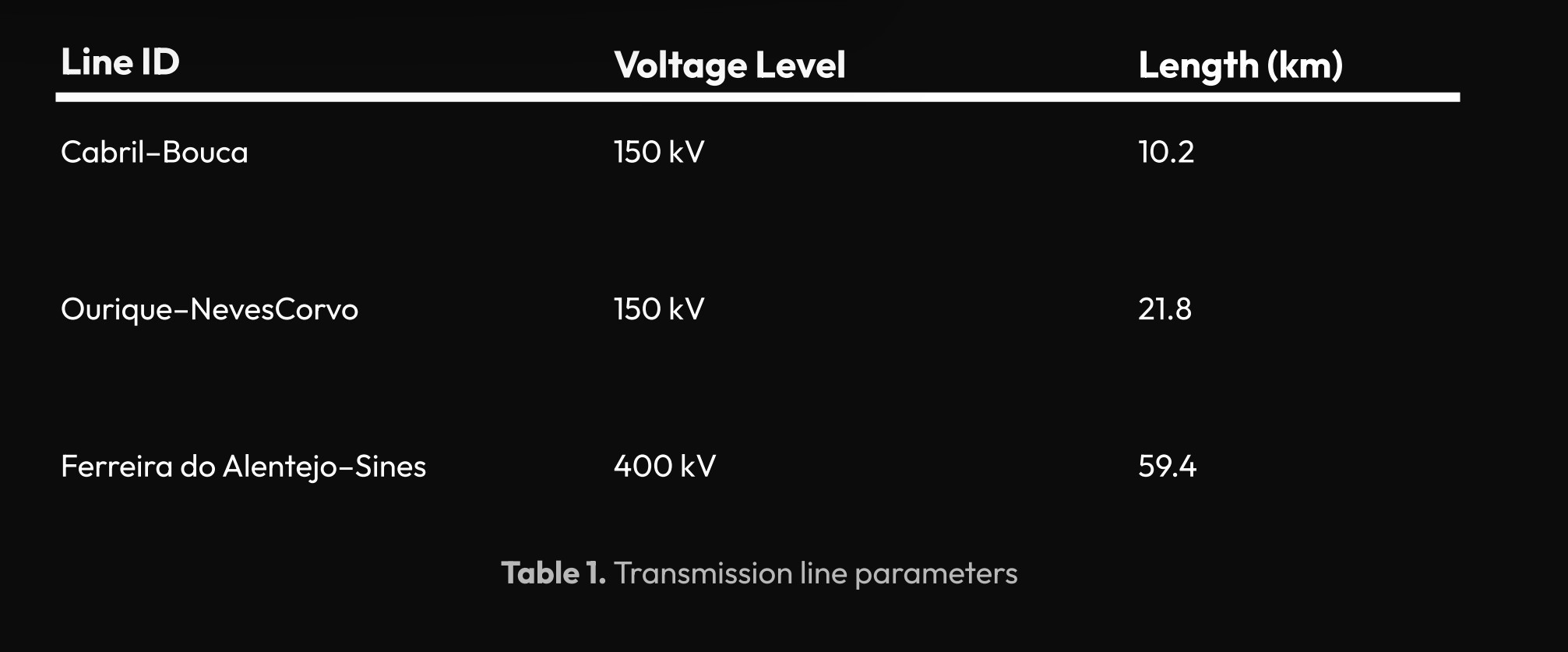
The Transmission line is the Ferreira do Alentejo to Sines 400 kV overhead line. It is 59.4 kilometers long and connects solar-rich inland areas with the Sines coastal energy hub.
This transmission line is strategically important because two major developments are planned:
A 1.2 GW photovoltaic complex known as the Fernando Pessoa project. It is expected to be the largest solar project in Europe.
A new data center cluster in Sines that will introduce significant additional electricity demand.
Under Static Line Rating assumptions, the transmission line appeared structurally constrained. Planning scenarios suggested reinforcement might be necessary to accommodate both renewable injection and future digital load.
However, meteorological conditions in the region indicated potential hidden headroom.
The transmission line crosses inland agricultural terrain and coastal areas exposed to maritime winds.
Inland sections experience cool winter nights and dry continental conditions. Coastal sections near Sines experience consistent wind exposure and higher humidity.
Preliminary weather analysis showed:
Winter night temperatures around 10 degrees Celsius near Sines
Average coastal winter wind speeds of approximately 5.2 meters per second
Reduced solar radiation during winter months
These factors significantly improve convective cooling of conductors.
Static Line Rating did not reflect these local climatic advantages.
Enline deployed Dynamic Line Rating to quantify the real thermal performance of three transmission assets in the region, including the 400 kV corridor and two 150 kV lines.
Results of the Dynamic Line Rating Deployment
The results were clear and measurable.
Across the Ferreira do Alentejo–Sines 400 kV line, Dynamic Line Rating regularly exceeded Static Line Rating by 20 percent to 40 percent.
During favorable winter wind conditions, peak uplift approached 80 percent above static limits.
Across all three evaluated lines, consistent capacity gains of approximately 20 percent were observed under normal operating conditions.
This demonstrated that static seasonal assumptions substantially underestimated real thermal performance.
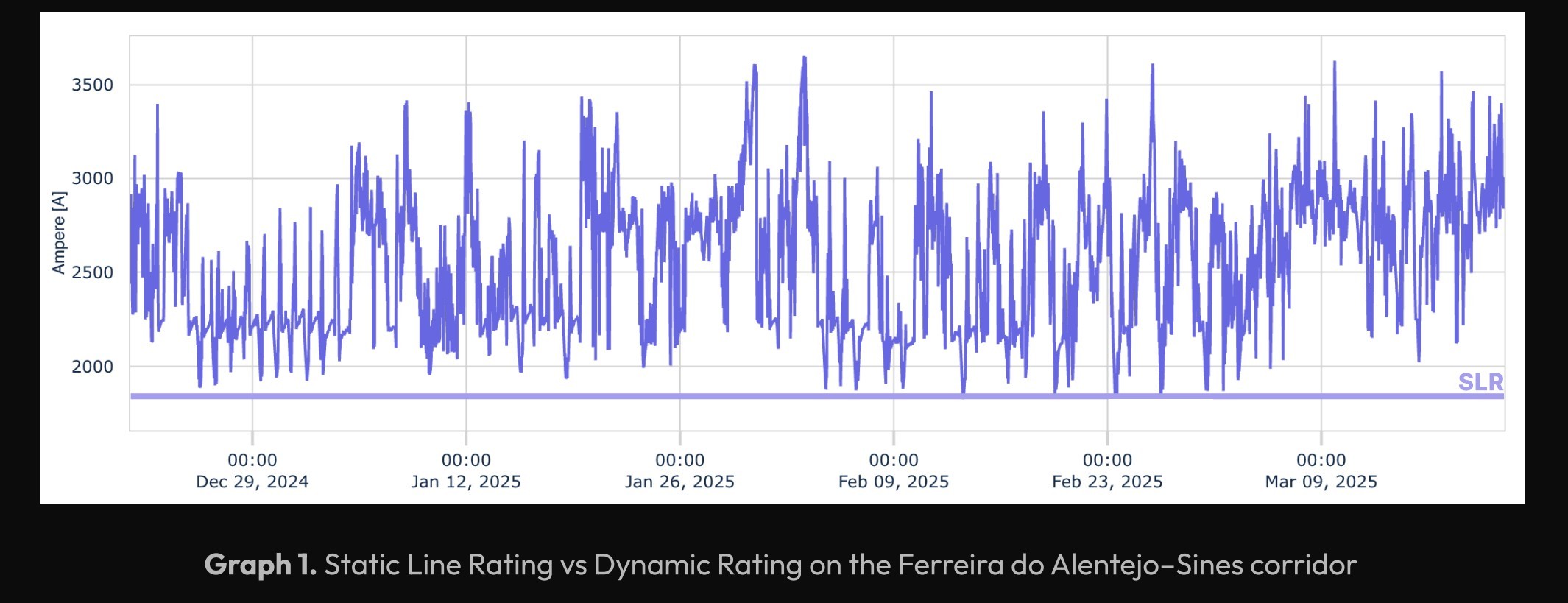
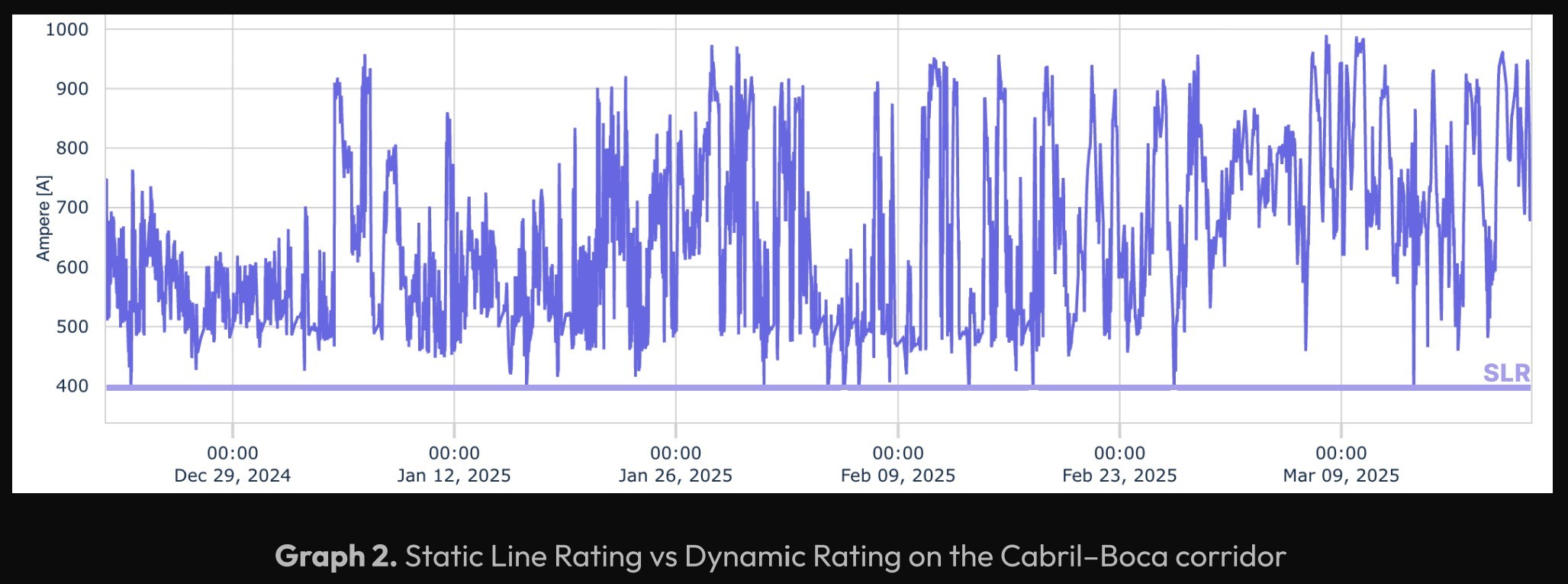
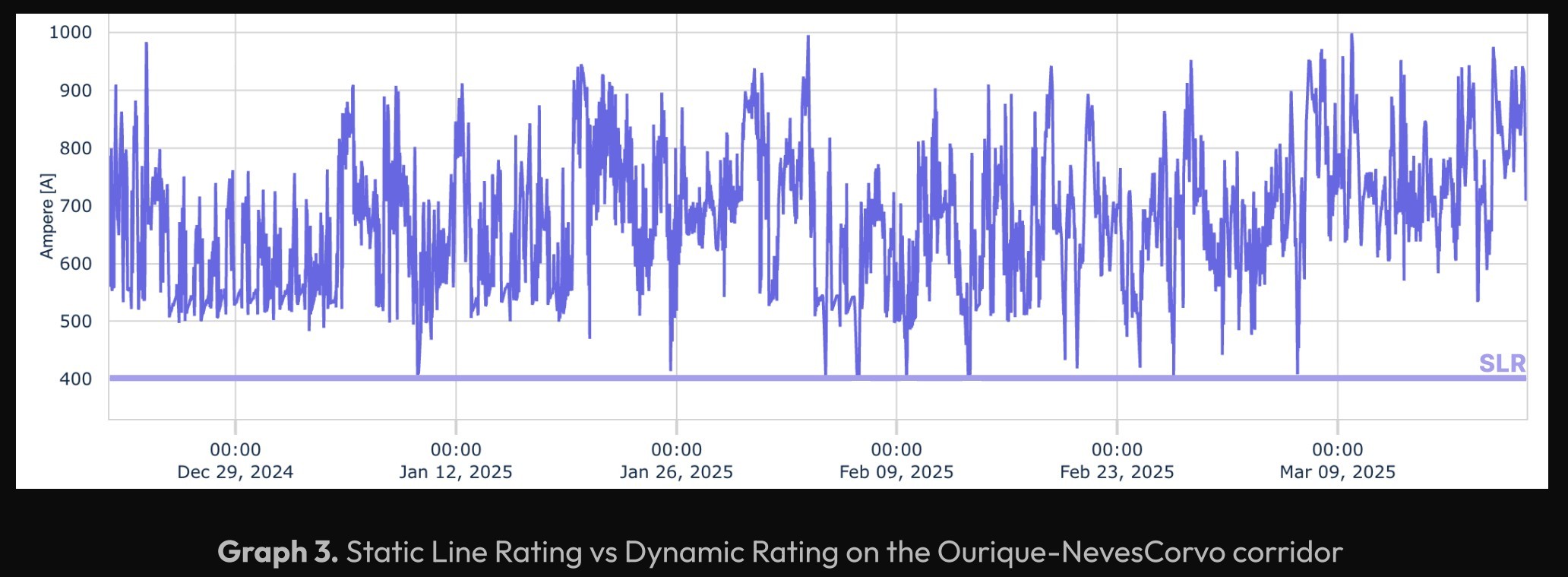
Several time intervals previously marked as rating-limited disappeared once real conductor behavior was modeled.
Congestion patterns shifted in both time and location.
This finding had direct implications for planning.
Strategic Impact of the Case Study
The deployment of Dynamic Line Rating fundamentally changed the planning perspective for this transmission corridor. The results were not incremental. They altered how congestion, investment timing, and operational flexibility were understood. The strategic impacts can be summarized in four key areas.
1. Congestion Was Partly Meteorological, Not Structural
The first and most important insight was that a portion of the apparent congestion was not caused by permanent infrastructure limitations. Instead, it was driven by conservative seasonal assumptions embedded in Static Line Rating.
When Dynamic Line Rating replaced static limits with physics-based modeling, several time intervals previously marked as constrained disappeared. Bottlenecks shifted in both duration and location. This demonstrated that part of the constraint was weather-driven rather than structural.
This distinction is critical for transmission planners. If congestion is structural, reinforcement is required. If congestion is meteorological, dynamic capacity can mitigate it without new infrastructure. By identifying which constraints were real and which were assumption-driven, the operator gained a more accurate understanding of the corridor’s true performance.
2. The Cost–Benefit Outlook for Reinforcement Changed
Transmission reinforcement decisions are based on cost-benefit analysis. When Static Line Rating underestimates available capacity, the economic case for new infrastructure may appear stronger than it truly is.
By quantifying measurable dynamic headroom, Dynamic Line Rating absorbed part of the justification for immediate expansion. Some of the expected overload scenarios were no longer persistent once real conductor behavior was modeled.
This does not eliminate the need for future investment. Security-driven upgrades remain essential.
However, it changes the timing, scale, and prioritization of reinforcement. Instead of reacting to assumed constraints, planners can now evaluate investments based on observable operating margins.
This leads to more efficient capital allocation and better regulatory justification.
3. Immediate Operational Headroom Created a Planning Bridge
The third impact was operational. Building a new transmission line typically requires one to three years for environmental licensing and an additional three to five years for construction. During this period, renewable growth and load expansion continue.
Dynamic Line Rating provided immediate, compliant headroom using existing infrastructure. This created a safe operational bridge while long-term reinforcement options are assessed and properly sized.
Rather than accelerating emergency investments based on static assumptions, the operator gained time. This time allows for improved forecasting, refined demand projections, and more accurate infrastructure planning.
In rapidly evolving corridors that will host large solar complexes and future data center loads, this flexibility is strategically valuable.
4. It Enabled a Technically Robust Path Toward Non-Firm Access
Many transmission operators are required to implement non-firm access mechanisms that allow additional generation or load to connect under conditional capacity limits.
Non-firm access requires a clear understanding of when and how much spare capacity is safely available. Static ratings do not provide this granularity.
Dynamic Line Rating quantifies variable but safe capacity envelopes throughout the year. This provides the technical foundation required to implement non-firm access without compromising system security.
In this case, Dynamic Line Rating supported the transition from a binary view of capacity to a dynamic framework that reflects real operating conditions. This is essential for integrating both renewable generation and future digital-sector demand.
This case clearly demonstrates that Dynamic Line Rating is not theoretical or experimental. It produces measurable, operationally significant results that directly influence congestion management, investment planning, and regulatory implementation.
By replacing conservative seasonal assumptions with real-time, physics-based intelligence, the operator gained a more accurate understanding of corridor performance and a more strategic basis for future decisions.
Dynamic Line Rating and Data Center Integration
Data centers require high and reliable transmission capacity. They also require predictable timelines.
If transmission reinforcement is required before load connection, delays can occur.
In the Portuguese corridor, Dynamic Line Rating revealed measurable headroom before the data center cluster becomes operational.
This allows planners to:
Stage connections
Evaluate reinforcement timing more accurately
Reduce near-term congestion risk
Dynamic Line Rating therefore plays a critical role in aligning renewable growth and digital infrastructure expansion.
Using Dynamic Line Rating for Smarter Reconductoring
Reconductoring is often considered when static ratings indicate limited capacity.
However, Dynamic Line Rating helps operators determine whether reconductoring is truly necessary.
By identifying when and where constraints occur, planners can:
Target specific spans instead of entire corridors
Phase upgrades based on real load growth
Avoid premature full-scale reinforcement
This improves capital efficiency while maintaining security standards.
Conclusion
The energy transition demands more from existing infrastructure. Renewable generation and digital demand are growing faster than transmission expansion.
Dynamic Line Rating unlocks measurable capacity from existing assets. It reduces curtailment, mitigates congestion, optimizes reinforcement timing, and supports future load integration.
The Enline deployment in southern Portugal demonstrates that conservative static ratings can significantly underestimate real thermal performance.
Dynamic Line Rating replaces fixed assumptions with physics-based intelligence.
For transmission operators, regulators, renewable developers, and digital infrastructure planners, Dynamic Line Rating is becoming a foundational technology for the modern power grid.
FAQs
1. Can Dynamic Line Rating help reduce electricity costs?
Yes. Dynamic Line Rating reduces congestion by unlocking additional transmission capacity under favorable weather conditions. This allows lower-cost generation, including renewables, to flow more freely, reducing redispatch expenses and curtailment. Over time, improved transmission efficiency can lower system costs that ultimately influence consumer electricity tariffs.
2. Can Dynamic Line Rating solve grid congestion?
Dynamic Line Rating can significantly reduce thermal congestion by aligning line capacity with real environmental conditions. While it does not resolve structural or stability constraints, it mitigates congestion caused by conservative static ratings and improves operational flexibility until long-term infrastructure upgrades are implemented.
3. What technologies enable Dynamic Line Rating?
Dynamic Line Rating relies on real-time weather data, conductor temperature modeling, digital twin simulations, forecasting algorithms, and integration with Energy Management Systems. Some solutions also use line sensors or sag monitoring. Together, these technologies calculate accurate, time-varying ampacity for operational and planning decisions.
4. How does Dynamic Line Rating work?
Dynamic Line Rating continuously calculates a transmission line’s safe current capacity based on wind speed, ambient temperature, solar radiation, and conductor characteristics. By modeling conductor thermal behavior in real time or through forecasts, it determines how much electricity can safely flow at any given moment.
5. What is line congestion?
Line congestion occurs when electricity demand for transmission exceeds a corridor’s rated capacity. This forces operators to limit power flows, redispatch generation, or curtail renewable energy. Congestion increases system costs and can delay new connections if transmission capacity appears constrained.
6. What is the Dynamic Line Rating solution?
The Dynamic Line Rating solution is a grid-enhancing technology that replaces static seasonal limits with real-time, physics-based capacity calculations. It provides operators with dynamic ampacity values that reflect actual conditions, enabling better congestion management, improved renewable integration, and more accurate infrastructure planning.