Article
May 21, 2026
Digital Power Grid Based on Digital Twin: Definition, Architecture, and Key Technologies for 2026
A digital power grid built on digital twin technology is now the operating layer of modern transmission and distribution. Learn the definition, architecture, and key technologies powering this shift, with verified case data from leading TSOs and DSOs. The classical power grid was designed to move electrons in one direction from large central plants to passive consumers. That model no longer reflects reality. Today's network must absorb gigawatts of variable renewables, integrate distributed batteries, electrify transport and heat, and serve AI data centres that ramp by hundreds of megawatts in minutes. The classical grid has no instrument capable of seeing all of that at once. The digital power grid, built on digital twin technology, is the instrument that closes the gap. It transforms the physical network into a continuously updated, simulation-ready, decision-capable digital ecosystem. This guide defines the concept, breaks down its architecture, and explains the key technologies that make a production digital twin actually work.
What Is a Digital Power Grid Based on Digital Twin?
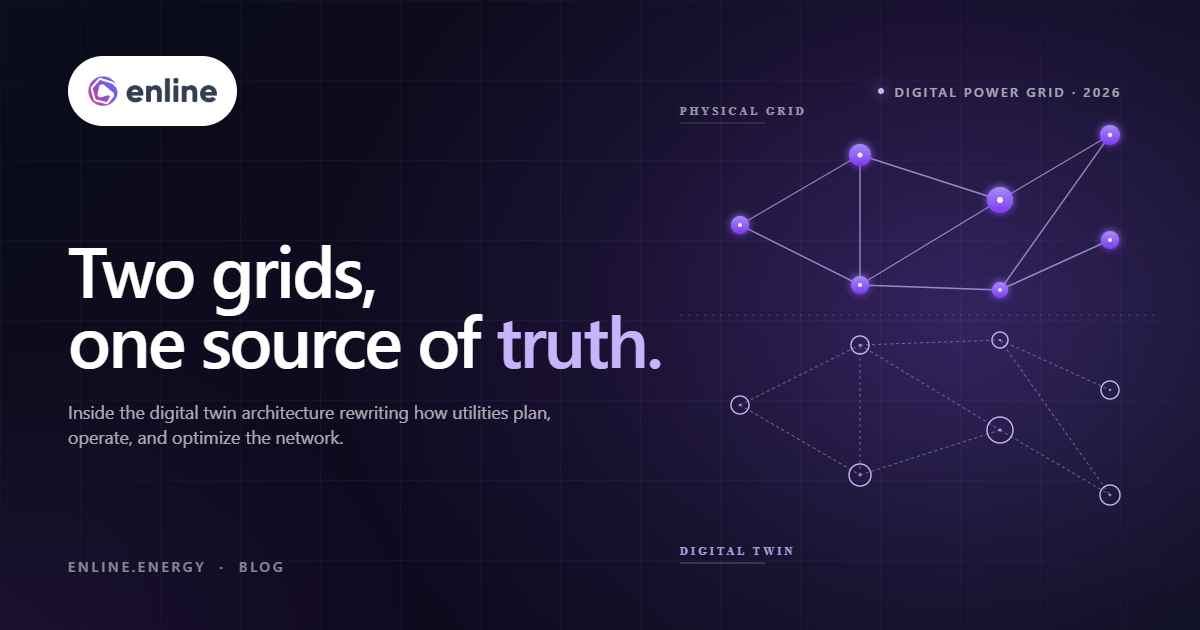
A digital power grid is a power system ecosystem in which a live virtual replica, the digital twin, runs in parallel with the physical network and continuously exchanges data with it. The twin ingests telemetry, geospatial models, asset records, weather, and market signals, then uses physics-based simulation and AI analytics to mirror, predict, and optimise the behaviour of the real grid.
The concept rests on three defining behaviours:
· Holographic replication. Every physical element of the grid (lines, transformers, substations, generators, DERs, even crews) carries a unique digital identifier and is represented inside the twin with its real geometric, electrical, and behavioural parameters.
· Twin interaction. Operations, planning, protection, and asset management are conducted first inside the digital world. Decisions are validated against the twin before they are executed in the field, and the field response is fed back into the model.
· Virtual-to-physical iteration. As conditions change (new loads, weather events, asset degradation, market shifts) the twin updates itself and feeds optimised guidance back to the physical grid. The two evolve together.
According to Fortune Business Insights, the electrical digital twin market reached USD 45.93 billion in 2026 and is projected to grow at a 34.69% CAGR through 2034. The market signal aligns with operational reality: regulators in the EU, the UK, Singapore, and an increasing number of US states now treat digital twin capability as a core grid modernisation requirement, not an optional upgrade.
Digital Power Grid Architecture: A Six-Layer Reference Model
A production-grade digital power grid is built across six integrated layers. Each layer has a defined function, and each one feeds the layer above it.
1. The physical power grid. This is the real network of generation, transmission, distribution, substations, and end-user assets. Every component carries a unique digital identifier and exposes standardised control interfaces, allowing it to receive feedback from the twin.
2. The perception layer. A dense, multi-modal sensing fabric measures both electrical (current, voltage, phase) and non-electrical quantities (temperature, vibration, sag, wind, irradiance). Modern deployments combine PMUs, IoT sensors, drone and satellite imagery, and edge-compute devices that process data locally before transmission.
3. The transport layer. A secure, bidirectional communication backbone moves data between sensors and the central platform. It blends optical fibre, 5G, NB-IoT, LTE, and power-line carrier into a heterogeneous network that delivers wide coverage, low latency, and cyber resilience aligned with IEC 62443 and NERC CIP.
4. The data layer. A unified data foundation ingests SCADA, GIS, AMI, asset registries, weather, and market feeds; reconciles them against the Common Information Model (IEC 61970/61968); cleans and validates them; and exposes them through governed APIs. This layer eliminates the silo problem that has historically blocked grid modernisation.
5. The platform layer. Physics-based simulation, AI and ML analytics, and decision-support modules run on the validated data model. Capabilities include state estimation, contingency analysis (N-1 and N-k), dynamic line rating, hosting capacity assessment, FLISR, DERMS, Volt-Var optimisation, vegetation risk forecasting, and crew dispatch. This is where the "power brain" lives.
6. The application layer. Operators, planners, asset managers, market traders, and field crews interact with the twin through role-specific applications, dashboards, and automated workflows. Customer service, regulatory reporting, and external stakeholder transparency are all built on the same shared model.
This is the architecture behind Enline's GridSight® digital twin platform, now deployed across more than 10,000 km of transmission and distribution networks on five continents.
Key Technologies That Make a Digital Power Grid Work
Five core technology categories determine whether a digital power grid delivers operational value or remains a dashboard.
· Intelligent sensing. Miniaturised, low-power, high-precision sensors (including TMR-based microcurrent sensors, fibre-optic temperature monitors, and conductor sag inclinometers) provide the raw observability that the twin depends on. Edge analytics filter and pre-process data at source, reducing backhaul load and enabling millisecond response.
· Heterogeneous communications. No single network technology covers a real utility footprint. Production deployments fuse 5G for high-bandwidth substation links, NB-IoT for low-power field sensors, fibre for backbone capacity, and private LTE for crew operations. Software-defined networking allocates bandwidth dynamically.
· Unified data and digital twin modelling. The twin is only as good as its model. High-fidelity electrical, thermal, and mechanical modelling of every asset (verified against field measurements) is non-negotiable. Open standards (CIM, IEEE 2030.5) prevent vendor lock-in.
· AI and the power intelligent brain. Machine learning layers handle load and renewable generation forecasting, asset health prediction, anomaly detection, and risk-based planning. Human-machine collaboration is essential: AI surfaces optimisation options, while engineers retain final authority on dispatch and protection decisions.
· Cybersecurity and digital business operation. The twin is a high-value cyber target. Zero-trust architectures, segmentation, continuous monitoring, and alignment with IEC 62443 and NERC CIP are mandatory. On the business side, the twin must integrate cleanly with planning, finance, customer service, and regulatory reporting workflows.
Real-World Deployments: Where the Digital Power Grid Already Works
The clearest evidence for the digital power grid concept comes from production deployments. Three current Enline collaborations illustrate the range of value the technology delivers in the field.
1. National TSO collaboration in Portugal (transmission, data centre corridor). In partnership with Portugal's national transmission system operator, Enline deployed GridSight® Dynamic Line Rating on a 400 kV corridor that will carry power from one of Europe's largest planned solar complexes (1.2 GW capacity) and serve a major future data centre cluster. The digital twin quantified true thermal headroom on a corridor that had been operated under static, conservative ratings, allowing the operator to defer reinforcement capex while accommodating new renewable injection and incoming AI load.
2. National TSO collaboration in the Netherlands (transmission). In a deployment with the Dutch national transmission operator, GridSight® DLR was rolled out across five overhead lines spanning 150 kV and 380 kV circuits in the southern part of the network. The collaboration delivered approximately 25% less curtailment, around 9 GWh per year of additional renewable energy dispatched, and an estimated €0.4 to €0.9 million per year in redispatch cost savings during the first operational year.
3. National TSO collaboration in Lithuania (national transmission rollout). Working with Lithuania's national transmission operator, Enline deployed GridSight® DLR across more than 1,000 km of transmission lines using a hybrid digital twin approach. The collaboration delivered an average 52% capacity gain, capacity that would otherwise have required years of new line construction and substantial reinforcement capex.
These collaborations span three European grids, multiple voltage classes, and renewable, data centre, and resilience use cases. The pattern is consistent: a properly engineered digital power grid delivers measurable capacity, reliability, and capex outcomes within the first year of operation.
The Bottom Line
The digital power grid based on digital twin technology has moved past concept. It is now the operating layer that determines whether transmission and distribution businesses can absorb data centre load, integrate renewables at scale, and meet climate-driven reliability targets without runaway capex.
Enline's GridSight® platform is the only full digital twin built specifically for the grid, with verified deployments across more than 10,000 km of network on five continents.
Request a demonstration to see how a unified digital twin can move your network from reactive operations to predictive, optimised control.
Frequently Asked Questions
What is a digital power grid in simple terms?
A power network that runs alongside a live, physics-accurate virtual copy of itself. Every decision can be tested in the digital version before being applied to the real one.
How is a digital power grid different from a smart grid?
A smart grid adds sensors, automation, and two-way communication to the physical network. A digital power grid adds a full virtual replica on top, enabling simulation, prediction, and optimisation that the smart grid alone cannot deliver.
Is a digital twin the same as SCADA?
No. SCADA collects and displays operational data. A digital twin uses that data, plus asset physics and AI, to simulate and optimise grid behaviour.
What standards govern digital power grids?
The Common Information Model (IEC 61970/61968), IEC 62443 for cybersecurity, IEEE 2030.5 for DER integration, and NERC CIP in North America are the most widely adopted.
How long does a digital power grid deployment take?
Modular deployments (for example, dynamic line rating only) can go live in months. Full enterprise-scale digital twins typically reach production within 12 to 24 months.
Does AI replace human grid operators?
No. The platform augments operators by surfacing capacity, risk, and asset insights that would otherwise remain invisible. Humans retain authority on dispatch and protection.