Article
May 22, 2026
Data Center Grid Limitations: The Power Bottleneck Holding Back the AI Era
AI data center electricity demand is outpacing grid build-out. Learn what is causing data center grid limitations, the five success factors for navigating them, and how digital twin technology unlocks hidden transmission capacity. The race to build artificial intelligence infrastructure has slammed into a hard physical wall: the power grid. While hyperscalers can stand up a new AI campus in 24 to 36 months, connecting that campus to high-voltage transmission can take four to ten years in most major markets. That gap, not chip supply, capital, or talent, is now the binding constraint on the AI transformation. This article explains the engineering and policy roots of data center grid limitations, the five success factors that separate stalled projects from energised ones, and the realistic timeline before the bottleneck eases.
AI Data Center Electricity Demand Is Reshaping the Grid
The numbers are no longer theoretical. According to the International Energy Agency, global data center electricity demand rose 17% in 2025, while AI-focused data center consumption surged 50% in the same year.
The IEA projects total data center electricity use will double by 2030 to around 945 TWh, and AI-specific demand will triple.
In the United States alone, the Energy Information Administration forecasts commercial electricity consumption to grow 5% in 2026, with data centers driving the bulk of that lift. Capital expenditure from the five largest hyperscalers exceeded $400 billion in 2025 and is set to grow another 75% in 2026. That investment is real. The grid capacity to absorb it is not.
AI data center electricity demand differs from previous load classes in three operationally critical ways: very high power density (often 50 to 100 MW per campus, rising to gigawatt scale), fast and uncertain ramping during training cycles, and very low tolerance for interruption. Together, these properties make AI loads the most challenging connection request grid operators have ever processed.
What's Causing Data Center Grid Limitations Across the U.S.?
Four compounding factors explain the current squeeze.
1. Interconnection queues at historic highs
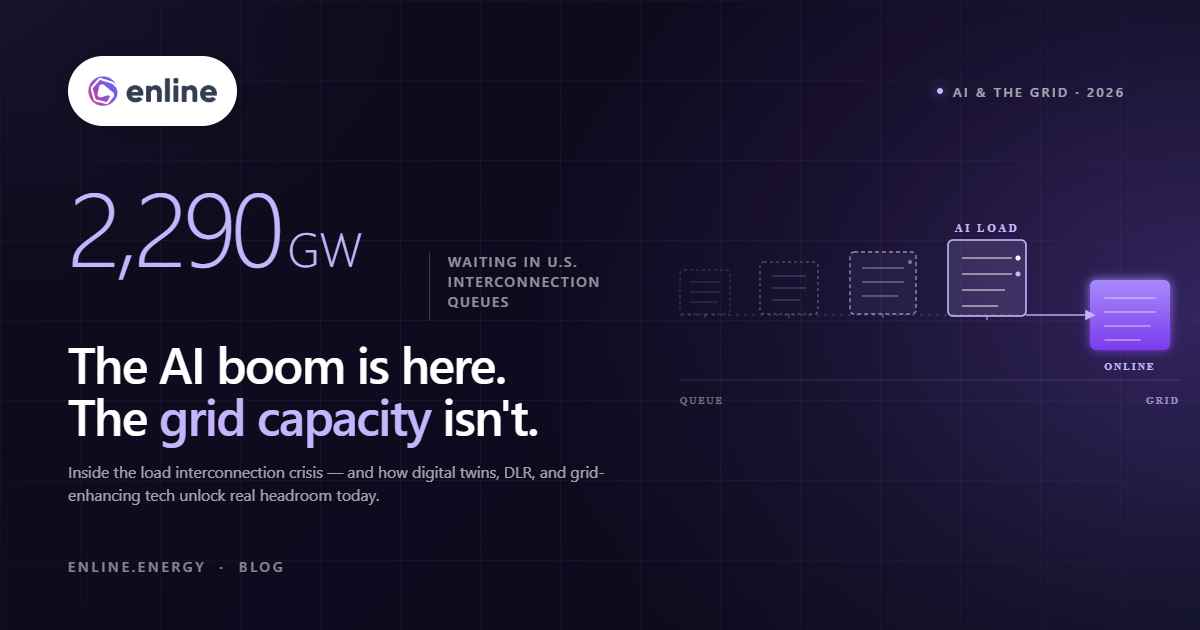
Lawrence Berkeley National Laboratory's 2025 Queued Up report found roughly 2,290 GW of generation and storage capacity actively waiting in U.S. interconnection queues at the end of 2024, almost twice the country's entire installed fleet. The typical project reaching commercial operation in 2024 spent 55 months, or 4.5 years, in queue.
2. Speculative load requests crowding the line
The IEA's Electricity 2026 outlook notes that only about 20% of U.S. data center connection requests actually materialise in the short to medium term. Utilities cannot easily separate firm projects from speculative ones, so reinforcement studies stall.
3. Transmission build-out is the slowest link
New 345 kV or 500 kV lines take seven to fifteen years from planning to energisation in most U.S. interconnections, according to data from the North American Electric Reliability Corporation (NERC). Permitting, right-of-way acquisition, and equipment lead times (large power transformers now run 120 weeks or more) all extend the critical path.
4. Conservative capacity assumptions on existing lines
Most transmission corridors are still operated using static line ratings set decades ago under worst-case ambient assumptions. Real conductor temperatures, governed by actual wind, irradiance, and ambient air, often allow 20% to 50% more current to flow safely. That headroom sits invisible to operators without modern monitoring.
These four factors together create what regulators have started calling a "load interconnection crisis." The U.S. Department of Energy issued a directive in October 2025 proposing federal jurisdiction over new loads above 20 MW, signalling that data center grid limitations have moved from a utility-level concern to a national-security-grade issue.
What Are the 5 Critical Success Factors for Navigating Grid Bottlenecks?
Developers, operators, and engineering teams who are getting AI projects energised on schedule share five disciplined practices.
1. Site selection driven by actual grid capacity, not land economics
The single biggest determinant of time-to-power is choosing a node where transmission headroom already exists. Sites near retired thermal plants, underutilised substations, or stranded renewable corridors can connect two to four years faster than greenfield positions in congested metros. Pre-investment capacity studies, including hosting capacity mapping and dynamic nodal congestion modelling, should precede any land commitment.
2. Behind-the-meter assets and hybrid generation
On-site batteries, fuel cells, limited gas peaking, and offsite PPAs let a data center begin operations within grid limits while reinforcements are still under construction. The IEA reports that on-site battery storage is becoming critical because gas plants struggle with the rapid demand swings characteristic of AI training workloads.
3. Interruptible "emergency lane" connection contracts
A 2025 DNV study of the Dutch transmission network estimated that managed-curtailment connections could unlock 5% to 15% of additional capacity in congested zones without compromising system security. Regulators in the Netherlands, the UK, and Texas are now formalising this option for new loads.
4. Demand flexibility and workload shifting
Non-urgent training jobs can be deferred or redirected to less congested geographic zones. Inference workloads can be prioritised by criticality. This is operationally trivial for hyperscalers and meaningfully reduces local grid stress.
5. Real-time grid intelligence through digital twin technology
Static assumptions hide capacity. A high-fidelity, physics-based digital twin of the network, fed by hyper-local weather and validated asset data, reveals true thermal margins in real time. Enline's deployment of GridSight® Dynamic Line Rating with Portuguese TSO REN on the Ferreira do Alentejo–Sines corridor, a 400 kV line serving the future Sines data center cluster, demonstrated how DLR quantifies real operating headroom on corridors that will carry new AI load.
Similar results have been independently reported: TenneT's Eindhoven–Rilland deployment delivered 25% less curtailment and typical thermal margins of approximately 20% above seasonal static limits in the first operational year.
In Lithuania, the national-scale GridSight® DLR rollout covering more than 1,000 km of transmission lines unlocked an average capacity gain of 52%, capacity that would otherwise have required years of new line construction.
How Long Will Data Center Grid Limitations Persist?
There is no single answer, but the consensus across the IEA, NERC, and major TSOs points to a multi-phase trajectory.
· 2026 to 2028: Acute bottleneck. Connection wait times in PJM, ERCOT, and most European TSO zones will remain in the four-to-seven-year range. Behind-the-meter generation, demand flexibility, and grid-enhancing technologies (GETs) such as DLR, advanced power flow control, and topology optimisation will carry most of the short-term capacity gains. FERC Order 2023 and Order 1920 reforms will begin to shorten queues, but their effects compound slowly.
· 2029 to 2032: Structural relief begins. Major transmission projects sanctioned in 2024 and 2025 reach energisation. SMRs and new gas generation enter service. The IEA expects natural gas and coal to supply over 40% of the additional electricity demand from data centers until 2030, with renewables meeting nearly half the growth at an annual average of 22%.
· Beyond 2032: New equilibrium. Grid build-out catches the demand curve, but only in regions that have invested in both physical infrastructure and digital twin platforms capable of running the network at higher utilisation safely.
The practical implication for AI developers, TSOs, and DSOs is clear: the projects that will be operational in 2028 are the ones securing real grid intelligence and adaptive capacity today.
The Bottom Line
Data center grid limitations are not a temporary inconvenience. They are the central engineering and policy challenge of the AI decade. The operators, developers, and engineering teams who treat the grid as an integrated, observable, optimisable system, rather than a static utility connection, will be the ones who actually deliver AI capacity at scale.
Enline's GridSight® digital twin platform gives TSOs, DSOs, and large energy users the visibility and optimisation tools to unlock hidden capacity, shorten connection timelines, and run the grid at true thermal limits safely. Request a demonstration to see how a unified digital twin can move your next AI project off the queue and onto the grid.
Frequently Asked Questions
Do AI data centers need a lot of electricity?
Yes. A single hyperscale AI campus can draw 100 MW to over 1 GW, comparable to a small city. The IEA estimates AI-focused facilities will triple their electricity consumption by 2030.
Where do AI data centers get power?
From the transmission grid in most cases, supplemented by on-site generation (batteries, gas, increasingly small modular reactors) and corporate PPAs with renewable plants. The IEA reports natural gas currently supplies about 26% of data center electricity, nuclear 15%, and renewables the fastest-growing share.
What supplies 80% of all energy in the world?
Fossil fuels (oil, coal, and natural gas combined) still account for roughly 80% of global primary energy consumption, according to the IEA's World Energy Outlook 2025.
Why do AI data centers increase the cost of electricity?
New large loads trigger transmission upgrade costs, which are partly socialised across all ratepayers. Tight supply-demand balances also push wholesale market prices upward, particularly in PJM and ERCOT.
How much water do AI data centers use a day?
A 100 MW AI data center using evaporative cooling can consume 1 to 5 million litres of water per day, depending on climate and cooling design. Closed-loop and liquid-immersion cooling significantly reduce this footprint.
How much electricity does 3,000 watts consume in 1 hour?
3,000 watts running for one hour equals 3 kilowatt-hours (kWh), the same as one unit on a standard electricity bill.