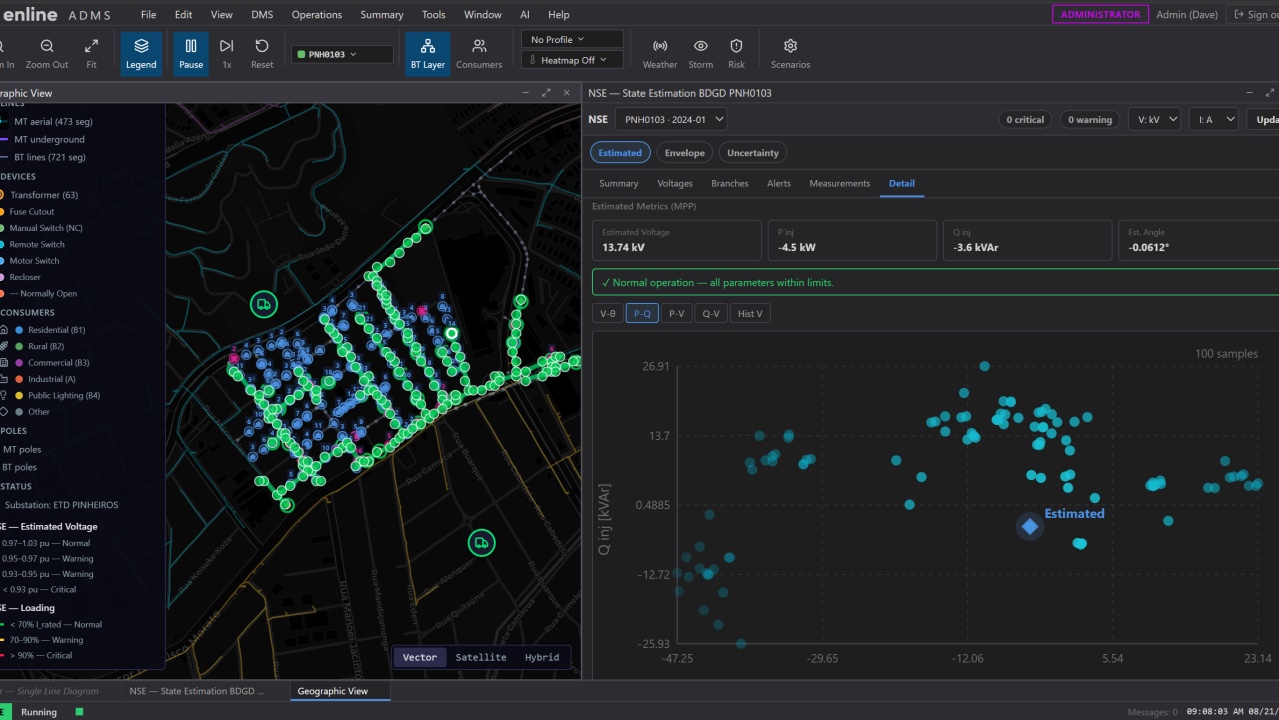
E-REDES open data shows that 47% of Portugal's HV distribution nodes have zero reception capacity, 87% of them because of line limits. This article reviews the EU and national reforms that now reward DSOs for optimising existing assets, and argues that DLR delivers that value only when deployed grid-wide. Evidence from E-REDES pilots indicates that a model-based, sensorless approach costs about a third of sensor-based DLR over five years, with ~90% lower upfront CAPEX, and around 2% of reconductoring at grid scale.
A grid redesigned by the energy transition
The distribution grid, the layer closest to consumers and producers, now absorbs most of the pressure for grid capacity. It was once treated as a purely radial, one-directional network. Renewable generation, battery energy storage, large-scale charging stations and other variable loads have redefined it. Today they push power in both directions across widely branched networks.
As a result, distribution operators increasingly face the same challenges as transmission operators: more variable and bidirectional flows, tighter margins and less real-time visibility.
Regulation is starting to respond. DSOs across Europe are entering tariff periods that, for the first time, tie remuneration to how efficiently existing network capacity is used, not only to how much new capacity is built. Dynamic ratings, Dynamic Line Rating (DLR) and Dynamic Transformer Rating (DTR), are the operational tool that makes this efficiency visible and actionable. They calculate ampacity in real time from actual weather and loading conditions, instead of fixed, conservative assumptions.
Focusing on DLR, two questions still stand in the way of large-scale adoption. Which regulatory incentives actually make deployment worthwhile? And how can a DSO cover thousands of kilometres of lines without inflating CAPEX? This article addresses both: the first through the reforms now under way, the second through how DLR is deployed at scale with Enline's technology.
The problem: congestion, a huge bill, and rules that are finally changing
Connection queues are a distribution problem now
The Netherlands shows where this leads. It has Europe's most congested grid, according to the IEA and the Regulatory Assistance Project.
Across the EU, roughly 455 GVA of battery-storage projects alone sit in distribution connection queues. Portugal, as we will see, has nearly half of its high-voltage distribution nodes closed to new generation.
The build-only answer is slow and lands on consumers' bills
Eurelectric estimates EU distribution operators must raise grid investment by 50-70% this decade, more than €375-425 billion by 2030.
There is also a cost loop. Every euro of reinforcement enters the regulated asset base (RAB) and is recovered, with a return, through network tariffs. Building more is the default answer to congestion, and it quietly raises the bill for the households and businesses the transition is meant to serve.
DLR breaks part of that loop. A conservative 10-20% capacity uplift could defer roughly €40-85 billion of the distribution investment gap. Enline modelled the tariff effect: rolling the RAB to 2035 (5% WACC, 40-year asset life, ~€37 billion a year of spend), the network-cost index rises about 14% on a build-led path, but only about 8% on a DLR-enabled path. That is a roughly 40% smaller increase for consumers.
Regulation now rewards using the grid you already own
Historically, tariff frameworks paid DSOs for capital deployed, not for getting more out of existing lines. Using a line more intelligently earned the operator nothing. Several reforms are now correcting that bias:
- EU Electricity Market Design reform (2024). Creates a right to flexible, non-firm connection offers in congested areas, and entitles grid users with a Power Control System to a flexible connection offer, and mandates quarterly publication of granular grid capacity data.
- European Grids Package. Building on the 2023 EU Action Plan for Grids, it pushes operators to optimise the existing network rather than default to costly expansion.
- The Netherlands. ACM and DSOs such as Liander and Enexis now offer capacity-limitation contracts and non-firm connections, trading variable capacity for faster access and lower tariffs.
- Portugal. ERSE gives E-REDES and REN financial incentives for flexible, non-firm access, rewarding higher asset utilisation. E-REDES publishes a quarterly reception-capacity map and has taken first steps toward a flexibility market. The National Energy and Climate Plan pushes for fast renewable growth even as connection wait times lengthen.
In this environment, DLR stops being a nice-to-have. It becomes the operational lever that turns regulatory incentives into connected megawatts. There is one condition: it has to scale.
The solution: software-first, model-based DLR
Why sensor-only DLR does not scale for DSOs
A DSO manages tens of thousands of kilometres of overhead feeders. A DLR strategy built only on physical sensors becomes a capital and maintenance programme of its own, with recurring operations, maintenance, communications and field-access costs. It recreates the very CAPEX problem DLR was meant to relieve.
There is a second, less discussed limit. A sensor measures the present. Grid operation is overwhelmingly predictive: day-ahead, intraday and real-time. Sensor-based DLR still needs a forecasting layer on top to be useful in the control room.
Enline's approach: a digital twin of the whole network
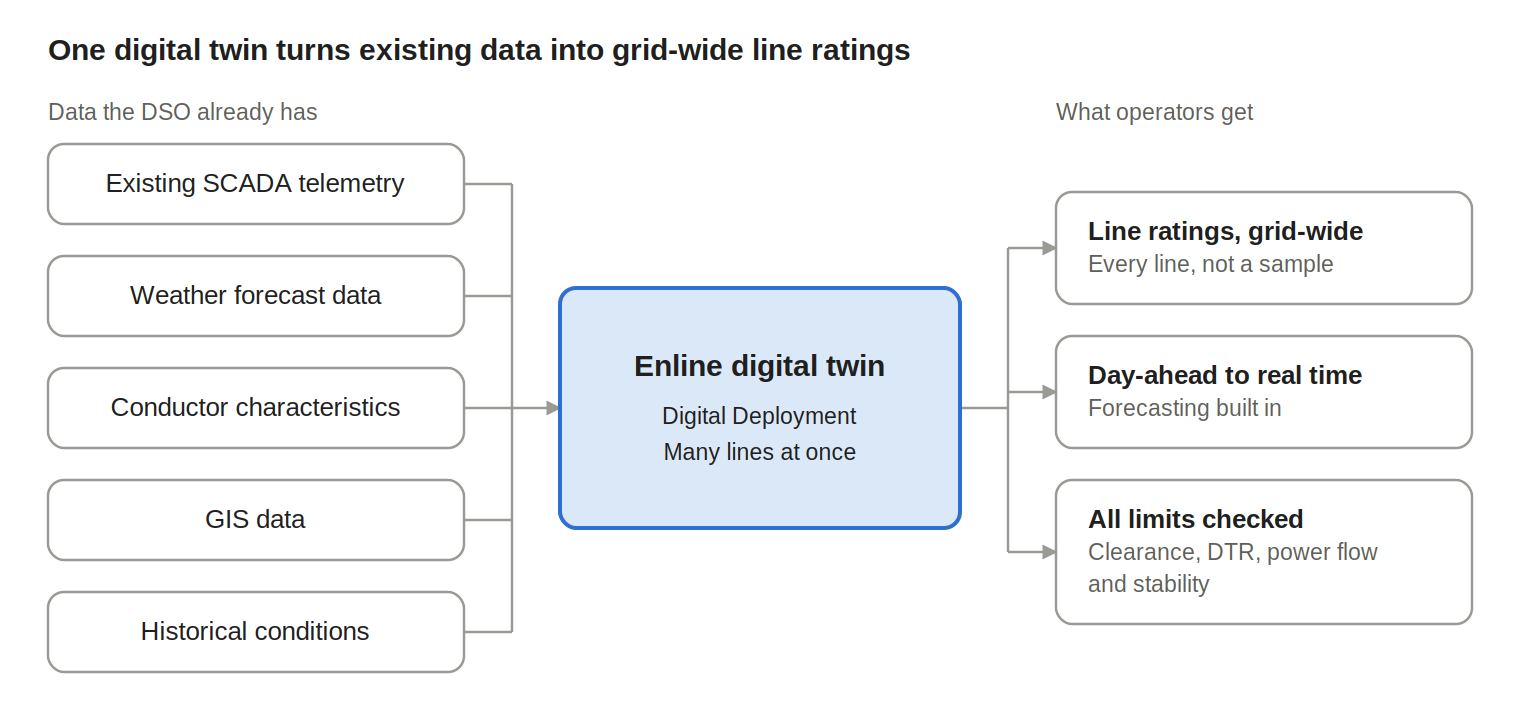
Enline flips the model. Its DLR is software-first and can run with no sensors at all. It builds a digital twin from data the DSO already has:
- Existing SCADA telemetry
- Weather forecast data
- Conductor characteristics
- GIS data
- Historical conditions
Because it runs on weather forecasts, the same model serves planning and day-to-day operations, from day-ahead to real time, without a separate forecasting tool.
From line-by-line to grid-wide
The key difference for DSOs is the grid view. Rather than treating each line as an isolated signal, the platform computes ampacity for many lines at once and checks it against every other limit: conductor clearance, dynamic transformer ratings (DTR), series-limiting equipment, power flows and stability criteria.
That lets operators raise capacity on several corridors together, with confidence that the next bottleneck has been checked. DLR shifts from a per-span hardware rollout to a software layer across an entire service territory. "Thousands of kilometres" becomes a routine deployment, not a blocker.
What this means for a DSO
- Scale. One software layer covers the whole service territory, not a sample of instrumented spans.
- Cost. Roughly 90% lower upfront CAPEX than a sensor-based rollout, and about a third of the five-year cost of ownership (E-REDES data, below).
- Grid view. Line ratings are checked together with clearance, transformer ratings, power flow and stability in one platform.
- Built-in forecasting. Ratings for day-ahead, intraday and real-time operation from the same model.
Case study: the Portuguese distribution grid
What the E-REDES pilots show
Encouraged by the regulator to trial innovative solutions, E-REDES carried out its own DLR evaluation. Its pilots are presented in Dynamic Line Rating in Practice: Comparing Sensor-Based and Sensorless Methods on the Portuguese Grid (CIRED 2026 Brussels Workshop, Paper 1241).
Two results from the pilots underpin this article:
- Capacity. The pilot measured an ampacity uplift of around 50%.
- Cost. Based on the pilot data, sensor-based DLR carries roughly ten times the upfront CAPEX of a sensorless, model-based approach. Indexed over five years at a 5% discount rate, the model-based total cost of ownership is about 36% of the sensor-based one, driven by roughly 90% lower upfront CAPEX.
For an operator covering thousands of kilometres, that cost difference is what makes grid-wide deployment realistic.
What full-scale DLR would unlock in Portugal
To estimate what the pilot results would mean in a large-scale deployment, Enline examined E-REDES's open data. Portugal is a fitting test bed: an Atlantic climate favourable to line cooling, and a grid robust and sizable enough for large-scale DLR. Using the quarterly reception-capacity map, each saturated HV node was classified by E-REDES's own stated reason, and releasable capacity was scaled from the pilot's measured gains alongside more conservative literature values.
Indicator (E-REDES HV network, 2025)
- HV nodes with zero reception capacity: 47% of 469
- Saturated nodes where the stated cause is a line limit: 87%
- Generation waiting behind saturated nodes: ~3.6 GVA
- Capacity free elsewhere in the network: ~10.3 GVA
- Generation queued specifically behind line limits: ~1.7 GVA
The message is clear. In Portugal, the barrier to new renewables is mostly the thermal current of overhead lines, chiefly the admissible current of 60 kV lines, and almost never the transformer. That is exactly the constraint DLR addresses.
The 184 line-limited nodes carry about 4 GVA at their ceiling. A conservative 10-30% DLR uplift re-opens roughly 0.4-1.2 GVA of hosting capacity: a quarter to three-quarters of the 1.7 GVA queue. At the pilot's ~50% uplift, the line-limited backlog could be cleared entirely.
The cost comparison closes the case. Based on regulated reference costs for distribution lines, such as CNMC's unit values of about €68,000/km for MV overhead lines and €120,000/km for 66 kV, a grid-wide, model-based DLR deployment would cost around 2% of reconductoring the same lines.
Method note: saturation is a point-in-time snapshot (zero reception capacity in the latest quarter); causes follow E-REDES's own justification text; uplift is scaled from the pilot and conservative literature values.
The bottom line
Europe's regulators are rewriting DSO incentives to reward the efficient use of existing grids. DLR is the tool that turns that incentive into connected capacity, but only if it scales affordably across whole territories.
The Portuguese data shows why that matters. Line limits are the main barrier to new connections on E-REDES's HV network. A model-based approach costs about a third of sensor-based DLR over five years, and could clear a quarter to all of the 1.7 GVA queued behind line limits, for around 2% of the cost of reconductoring.
The capacity is already in the ground. Software is how DSOs unlock it, fast.
Authors: Felipe Loose, João Galamba and Paulo Monteiro, Enline. Adapted from the white paper "Dynamic Line Rating at the Distribution Edge".
Sources
- E-REDES, Dynamic Line Rating in Practice: Comparing Sensor-Based and Sensorless Methods on the Portuguese Grid, CIRED 2026 Brussels Workshop, Paper 1241
- E-REDES Open Data platform, reception-capacity map (2025)
- Eurelectric, distribution grid investment needs to 2030; IRENA and Energy Transitions Commission on DLR deferral; ACER/CEER tariff structure
- EU Electricity Market Design reform (2024); European Grids Package; EU Action Plan for Grids (2023)
- IEA, Grid congestion is posing challenges for energy security and transitions (2024); RAP, Gridlock in the Netherlands (2024)
- ACM, binding arrangements on flexible contracts, congestion management and grid utilisation (2024)
- E-REDES, First steps in the flexibility market in Portugal (2022); ERSE; PNEC 2030
- CNMC, reference unit investment values; PG&E Unit Cost Guide (2026)