~70%.
Inspection-time reduction vs. field and aerial patrol averages.
Retroactive simulation confirmed the risk would have been caught, and that became the case for GridSight® VGM.
The fallen tree wasn't just a local fault. It was the point where reactive vegetation management stopped being a viable strategy, and got too expensive to ignore.
No predictive monitoring in place. A storm that made the case for it.
Before the storm, vegetation management along this corridor was driven by a fixed inspection schedule rather than measured risk. The utility operated more than 1,000 km of transmission lines through dense tropical terrain, with no predictive monitoring in place. Instead, maintenance relied entirely on manual and helicopter inspections carried out just a handful of times a year.
It was costly and it wasn’t working: the network was still experiencing two to three vegetation-related outages every year.
In late 2025, a severe storm hit a mountainous region of Latin America. Wind and heavy rain brought down a large tree onto a 33 kV transmission line, cutting power to more than 1,700 consumers.
The storm added €95,000 in additional costs nearly half the annual vegetation management budget in a single event. After the incident, LiDAR and imagery analysis showed that the fallen tree was in an area with high vegetation density and unstable slopes exactly the kind of high-risk location the monitoring system is designed to identify, but one the utility wasn’t monitoring.
| Metric | Basis | Result |
|---|---|---|
| Inspection time | 0.4 h/km × 100 km | 40 hours per 100 km |
| Annual cost | €120/km × 1,000 km × 2 cycles/year | ≈ €240,000 |
| Incidents per year | 0.25 incidents per 100 km × 1,000 km | 2-3 incidents |
Retroactive simulation showed that the risk could have been caught. The evidence made the case for bringing GridSight® VGM onto the network.
Running the site back through GridSight® Vegetation Management, using LiDAR and historical orthophotography for that corridor, showed the tree would have been flagged as on track to cross the clearance threshold: scheduled for preventive pruning weeks before the storm hit, had predictive monitoring been in place.
Following that retroactive analysis, the utility brought GridSight® VGM onto the network for the first time, embedding its alerts directly into daily maintenance planning and putting 437 km of transmission corridor under continuous monitoring.
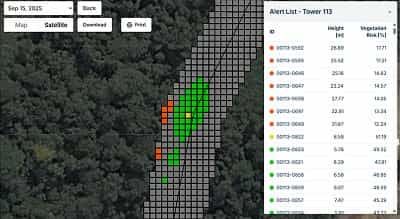
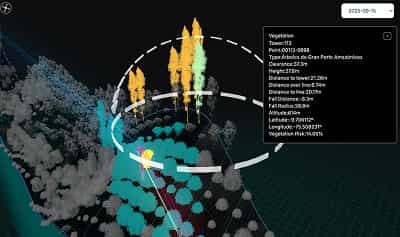
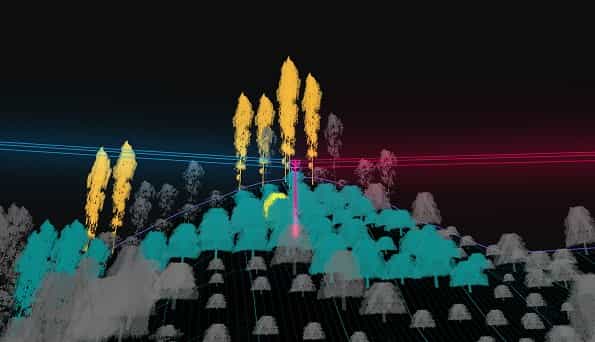
Reactive patrols replaced by continuous, risk-driven monitoring.
Across Enline's broader GridSight® VGM portfolio, the gains hold up consistently across deployments. Applied to this corridor's 437 km of now-monitored network, that points to estimated annual savings of €60,000-€80,000 against a baseline spend of roughly €240,000 a year, plus fewer emergency callouts and reactive fixes.
With GridSight® VGM now part of daily maintenance planning, vegetation risk on this corridor gets caught and addressed before it turns into a failure, not after. The line between an outage and uninterrupted supply here wasn't repair speed: it was whether anyone was watching the vegetation before the storm hit.
Inspection-time reduction vs. field and aerial patrol averages.
OPEX savings, verified across customer deployments.
Outage-risk reduction: incident frequency, before vs. after VGM.
Carbon-footprint reduction: fewer helicopter hours and field trips.