Article
Apr 20, 2026
The Missing Layer in Grid Modernization: Digital Twin and Dynamic Line Rating for Transmission Intelligence
Static line ratings are leaving capacity on the table. Enline's GridSight digital twin and dynamic line rating platform reveals what your grid can actually carry.
The Missing Layer in Grid Modernization
The energy industry has invested heavily in grid modernization over the past decade. Smart meters, advanced metering infrastructure, wide-area monitoring systems, phasor measurement units, upgraded SCADA platforms. The physical and digital infrastructure of transmission and distribution networks has improved considerably across every major grid in the world.
And yet, across most transmission systems, operators are still making real-time decisions on the basis of thermal ratings that were calculated months or years ago under hypothetical worst-case environmental assumptions. The hardware is smarter. The operating framework is not.
This disconnect represents the most consequential and underappreciated gap in grid modernization as currently practiced. The industry has prioritized the digitization of existing processes over the transformation of those processes. More data is being collected. More of it is being visualized. But the fundamental operating models, including the static assumptions that define how much a line can carry, have remained largely unchanged.
The Problem: Static Line Ratings in a Dynamic Grid
A static line rating assigns a fixed maximum ampacity to a transmission conductor based on worst-case summer ambient temperature and near-zero wind speed. This conservative assumption is designed to prevent conductor overheating under the most demanding possible conditions. It makes sense as a safety floor. It makes no sense as the ceiling from which operators manage the grid every hour of every day.
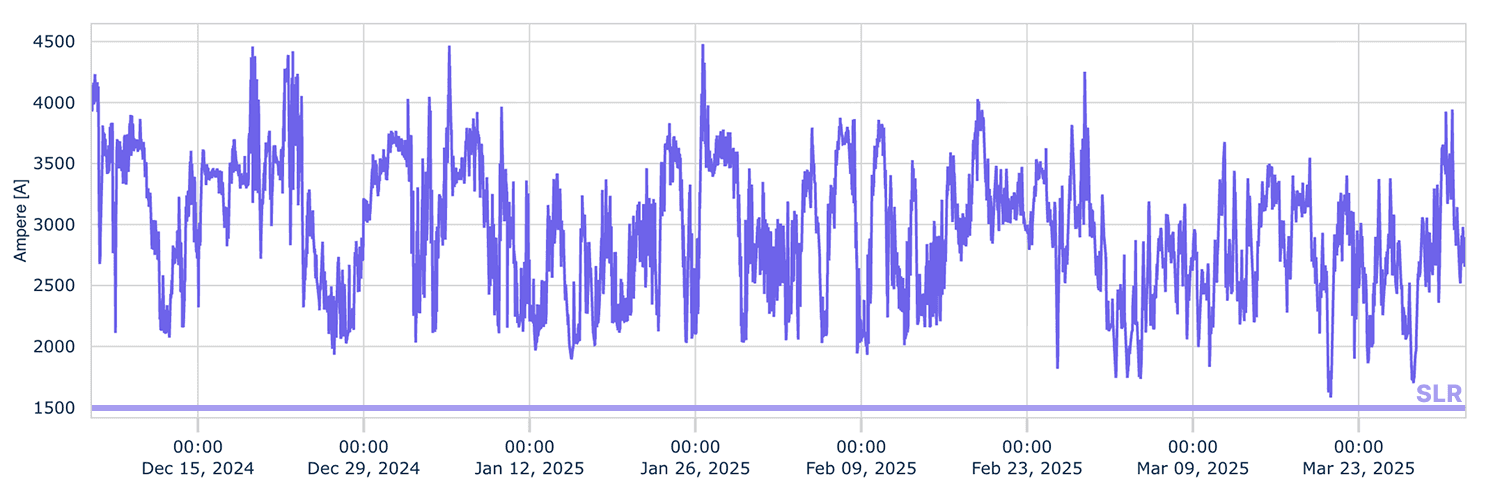
Static ratings are unnecessarily restrictive for 70 to 90 percent of operating hours. During cooler months, windy conditions, or nighttime operation -- all of which dramatically increase the convective cooling of a conductor -- the actual safe ampacity can be 20 to 80 percent higher than the static rating permits. That gap is not theoretical headroom. It is capacity that currently cannot be dispatched, renewable generation that must be curtailed, and congestion costs that must be passed to consumers.
The consequence is visible in every major transmission system. Congestion costs in PJM alone have exceeded billions of dollars annually in recent years. Curtailment of wind and solar generation in ENTSO-E regions runs into tens of terawatt-hours per year. Interconnection queues in the United States contain more than 2,600 gigawatts of proposed capacity, much of it delayed by transmission constraints that are partially artificial, created not by physical insufficiency but by outdated operating models.
What Dynamic Line Rating Actually Does
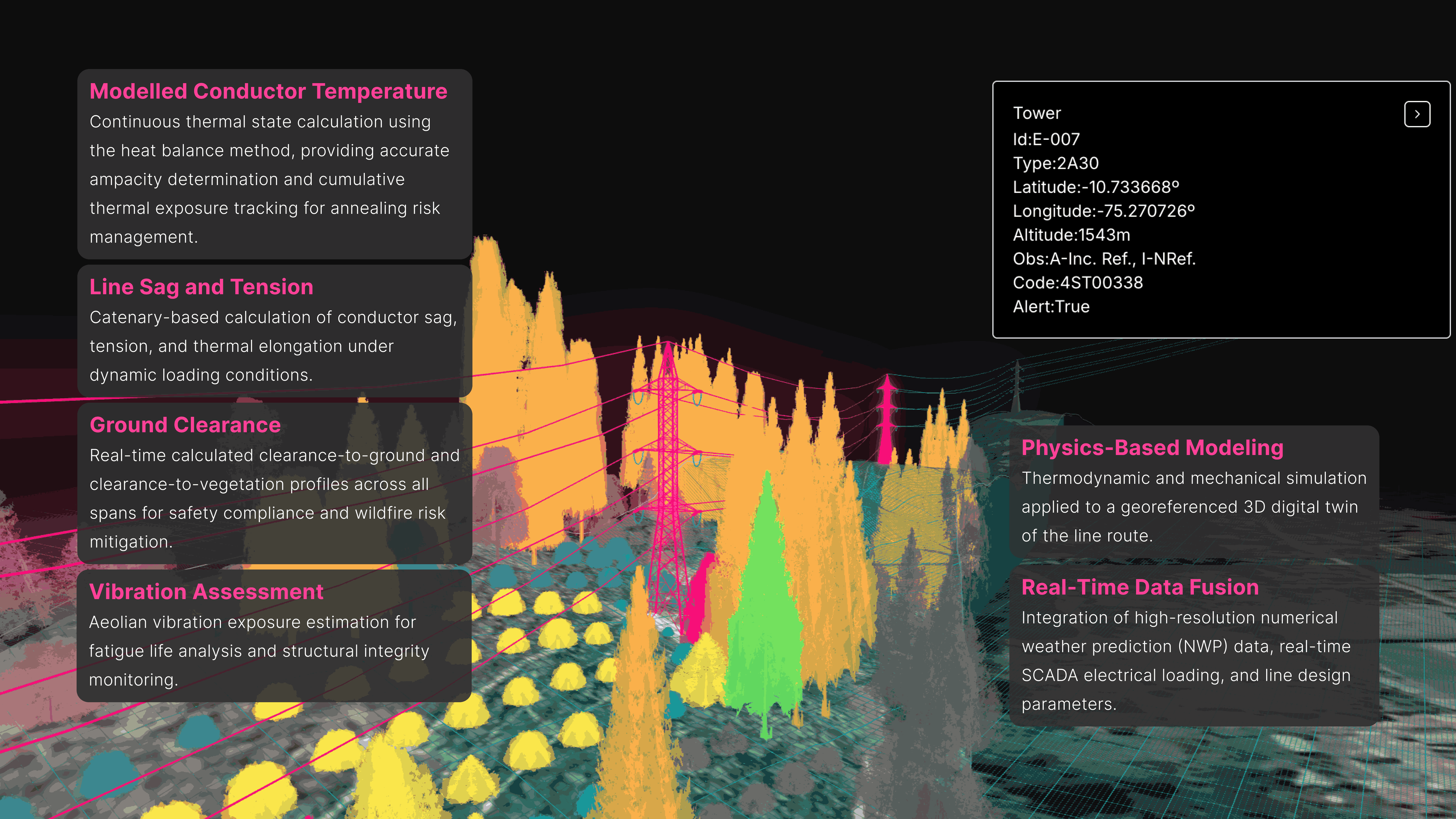
Dynamic line rating (DLR) replaces the fixed worst-case assumption with a continuous, physics-based calculation of real conductor thermal capacity. Enline's GridSight DLR fuses real-time SCADA loading, high-resolution numerical weather prediction, and physics-based conductor thermal modelling (IEEE 738, CIGRE TB 601) into a georeferenced 3D digital twin of the line, recalculating ampacity every one to fifteen minutes at the span level.
The result is not an estimate or a forecast in isolation. It is a continuously validated operational rating that reflects what the line can actually carry right now, and what it is forecast to carry over the next 36 to 240 hours. That forecast capability is what enables DLR to move from real-time awareness into day-ahead scheduling, interconnection capacity allocation, and renewable integration planning.
Critically, GridSight DLR is a 100 percent software-based solution. No line outages are required for deployment. No field instrumentation or live-line work is necessary. Data inputs are drawn from existing grid design parameters, line route geometry, and real-time SCADA feeds that operators already have. Deployment costs are typically 5 to 7 percent of an equivalent reconductoring or line rebuild investment.
The Digital Twin: From Monitoring to Operational Intelligence
Dynamic line rating is a necessary component of grid modernization, but it is not sufficient on its own. A thermal rating, however accurate, only tells an operator how much current a single conductor can safely carry. Transmission operation requires understanding what the entire connected system can do under N-1 security conditions, how switching configurations affect available transfer capability across corridors, and how each of these parameters will evolve over the next ten days.
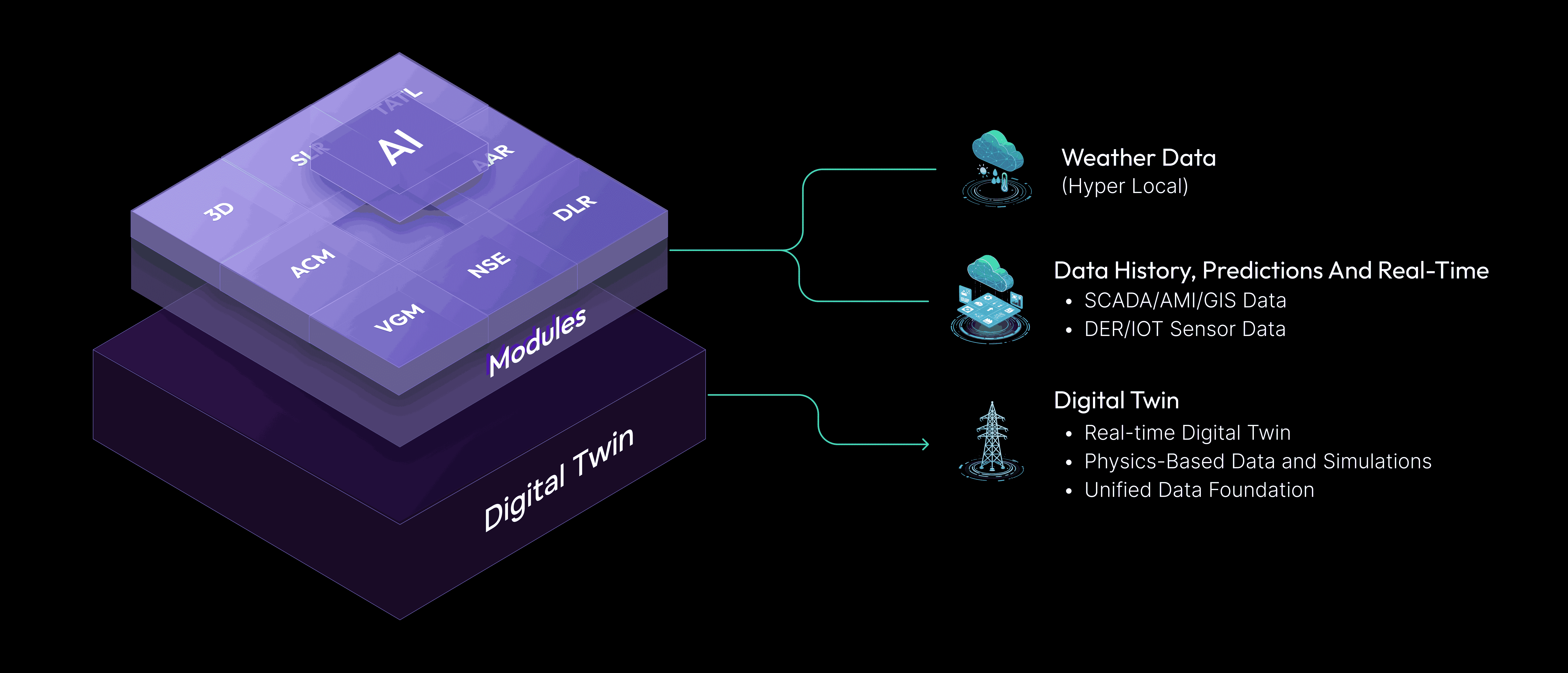
This is where the power grid digital twin becomes the enabling layer. A digital twin of the transmission network is a continuously updated, physics-based computational model that mirrors the real network in real time. It is not a visualization tool or a static engineering model. It is a live operational platform that consolidates SCADA telemetry, NWP inputs, line design parameters, and DLR outputs into a single coherent picture of network state.
Enline's GridSight platform delivers this in two configurations designed for the specific operating environments of transmission and distribution networks:
GridSight AEMS (Advanced Energy Management System) is built for transmission system operators (TSOs). It delivers a digital twin-based platform that consolidates the entire transmission network into a single real-time operational model, breaking down the data silos that currently force operators to navigate disconnected tools and accept the blind spots they create. GridSight AEMS integrates directly into existing EMS infrastructure via standard utility communication protocols, appearing in existing operator displays without requiring new interfaces or retraining.
GridSight ADMS (Advanced Distribution Management System) brings the same approach to distribution system operators (DSOs). It enables dynamic capacity management, integration of renewables, storage, electric vehicles, and large loads -- all within a continuously validated digital twin that mirrors the evolving complexity of the distribution network. Modules cover FLISR (Fault Location, Isolation and Restoration), DERMS (Distributed Energy Resources Management), Volt-Var Optimization, Outage Management, and predictive asset health monitoring.
Both platforms are hardware-light, EMS-integrated, standards-aligned, and modular by design.
Enline DLR Results Across Two Transmission Corridors
The argument for transmission intelligence does not rest on modelling alone. It rests on measured operational results from real transmission systems.
On a 107-kilometre corridor in the south of the Netherlands, spanning 380 kV and 150 kV transmission lines and serving as a backbone for transferring offshore wind and onshore solar inland toward major load centres, Enline DLR was deployed across five lines between 2024 and 2025. Before deployment, the corridor experienced approximately 35 GWh per year of renewable curtailment and more than 6,100 hours per year of potential underloading constrained by conservative static ratings. After deployment, the results were clear: a 20 percent average thermal capacity increase, a 25 percent reduction in renewable curtailment, and estimated redispatch savings of 0.4 to 0.9 million euros per year.
On a strategic 400 kV corridor in southern Portugal, spanning 59.4 kilometres through terrain facing growing pressure from utility-scale solar and planned data centre load, Enline DLR and the digital twin platform delivered average capacity gains of 20 to 40 percent, which became the new operational baseline. During winter wind conditions, peak ampacity uplifts reached 80 percent above static ratings.
The capacity was never missing. Enline DLR just made it visible.
These results are not outliers. They represent what becomes visible when the right intelligence layer meets existing infrastructure. Both corridors were not physically insufficient. They were operating below their actual capability because their operating models did not reflect actual conditions.
The Policy Moment: SPARK and FERC Order 881
Regulatory frameworks are beginning to reflect what operators and utilities are discovering operationally. In the United States, two developments are particularly significant.
First is the FERC Order 881, which came into effect in 2023, requires transmission providers to use ambient-adjusted ratings (AARs) as the minimum standard for thermal rating methodology. While AARs are a step beyond purely static ratings, they represent a floor, not the ceiling that DLR enables. GridSight DLR is designed to deliver FERC Order 881 compliance as a baseline, with full physics-based DLR as the operational standard above it.
The SPARK programme (Speed to Power through Accelerated Reconductoring and other Key Advanced Transmission Technology Upgrades), administered by the US Department of Energy under IIJA Section 40107, represents a broader policy recognition that integrated operational intelligence, combining DLR, topology optimization, forecasting, and EMS integration, is not an optional upgrade. It is the enabling condition for meeting near-term capacity requirements without waiting years for new transmission construction.
Enline has submitted a concept paper under SPARK Topic Area 2, targeting transfer capability increases of 25 percent or more on existing US corridors within 12 months of deployment.
In Europe, the same logic applies across ENTSO-E's most congested corridors. The constraints on these corridors are not primarily physical but operational. Changing the operating models applied to them and providing the intelligence layer that makes dynamic operation possible, does not require a new right-of-way. It requires a new way of seeing the network.
Topology Optimization
Beyond DLR, the digital twin platform enables topology optimization (TO) -- the identification and execution of switching configurations that unlock additional network-level transfer capability by redistributing power flows across the grid. TO algorithms are only as effective as the thermal data they consume. If fed static ratings, TO solutions are inherently conservative. Fed with Enline's real-time span-level ampacity values via the EMS, TO software can identify and safely execute switching configurations that unlock substantially greater network-level transfer capability.
Industry evidence indicates that topology optimization can reduce congestion costs by 25 to 50 percent and renewable curtailment by up to 50 percent when combined with accurate real-time line data. GridSight provides exactly the data layer that makes this possible, delivering the combination that FERC, DOE, and the WATT Coalition identify as the highest-priority grid enhancing technology stack for existing infrastructure.
Conclusion
Grid modernisation is not finished when the digital infrastructure is in place. It is finished when the operating intelligence matches the physical capability of the network. For most transmission systems in the world, there is still a significant distance between those two points.
That distance is not measured in new substations or new rights-of-way. It is measured in the gap between what a conductor can actually carry under today's conditions and what operators are currently permitted to dispatch. It is measured in curtailed gigawatt-hours, unnecessary redispatch costs, and renewable generation that reaches a grid that cannot absorb it.
The intelligence layer that closes this gap is available now. It requires no new infrastructure. It delivers capacity increases within months, not years. And on every corridor where it has been deployed -- from Zeeland to Sines -- it has revealed exactly what the network was always capable of carrying.
That is the missing layer. And finding it does not require building anything new.
FAQs
What is the difference between static line rating and dynamic line rating?
A static line rating assigns a fixed maximum ampacity to a transmission line based on worst-case environmental assumptions, typically peak summer temperatures and minimal wind. Dynamic line rating (DLR) recalculates conductor ampacity in real time based on actual weather conditions along the line route, using physics-based heat balance models. DLR typically delivers 10 to 20 percent additional thermal capacity on an annual average basis, with peak uplifts of up to 80 percent during favorable conditions.
What is a power grid digital twin?
A power grid digital twin is a continuously updated computational model of a real transmission or distribution network. It fuses SCADA data, numerical weather prediction, line design parameters, and real-time sensor inputs to mirror the actual state of the network. Unlike a static engineering model, a digital twin is a live operational tool that enables real-time capacity assessment, 10-day capacity forecasting, and integration with EMS decision-support systems.
What is GridSight DLR?
GridSight DLR is Enline's dynamic line rating and digital twin platform for transmission and distribution lines. It calculates real-time and forecast thermal ratings using physics-based modelling (IEEE 738, CIGRE TB 601), numerical weather prediction, and SCADA telemetry. It is hardware-free, requires no line outages for deployment, and integrates directly into existing EMS/SCADA infrastructure. Proven deployments include TenneT in the Netherlands (20 percent capacity increase, 25 percent curtailment reduction) and REN in Portugal (20 to 40 percent average capacity gain, 80 percent peak uplift).
Can dynamic line rating help with grid congestion?
Yes. Grid congestion on many transmission corridors is partially caused by static operating assumptions rather than physical infrastructure limits. DLR reveals the additional thermal headroom that existing conductors actually have under real-world conditions, directly reducing binding congestion hours and associated redispatch costs. When combined with topology optimization, the congestion reduction effect compounds further.
Enline's GridSight platform is deployed by TSOs and DSOs across Europe and Latin America. For technical documentation, case studies, or a corridor feasibility assessment, contact the Enline team at enline.energy.