Article
Apr 6, 2026
Power Grid Stability in the Age of Renewables: The Case for Dynamic Line Rating and Digital Twin Intelligence
Power grid stability is evolving with renewables. Discover how Dynamic Line Rating and digital twin intelligence unlock capacity, reduce congestion, and optimize grid performance with Enline solutions.
The power grid is no longer the passive infrastructure it was designed to be. For decades, it operated as a one-directional system: electricity was generated at centralized plants, transmitted over high-voltage lines, and distributed to end consumers. System operators planned conservatively, built generously, and managed predictably.
That era is over.
Today, Transmission System Operators (TSOs), Distribution System Operators (DSOs), and utilities are managing a fundamentally different challenge. Renewable generation is intermittent and geographically dispersed. Demand patterns are shifting with electrification and the infrastructure that underpins it all, hundreds of thousands of kilometers of aging transmission lines, is being asked to carry more than it was ever designed to handle.
The question is no longer whether the grid needs to evolve. The question is whether the organizations responsible for it are moving fast enough, and whether they are adopting intelligent solutions such as those developed by Enline to keep pace with this transformation.
What Is a Power Grid?
A power grid is the interconnected network of infrastructure that generates, transmits, and distributes electricity from source to consumer. At the highest level, it consists of three primary components: generation assets including thermal, nuclear, hydro, wind, and solar; transmission networks that carry bulk electricity at high voltages over long distances; and distribution systems that step down voltage and deliver power to homes, businesses, and industry.
In most countries, this infrastructure is divided between TSOs, those responsible for managing the high-voltage energy highways that move bulk power across regions, and DSOs, those who control the local networks delivering electricity to end users. Utilities may operate across both segments or serve specific functions within them.
For TSOs in particular, the increasing complexity of grid operations is driving the adoption of advanced solutions such as AEMS by Enline, designed to optimize transmission networks, maximize capacity, and ensure system stability while supporting efficient expansion planning.
The grid's fundamental purpose has not changed. It still maintain balance between supply and demand, keeping frequency and voltage within safe limits, and ensure that electricity reaches consumers reliably and affordably. What has changed is the complexity of doing so, and the growing need for real-time grid intelligence platforms like those provided by Enline.
How Do Power Grids Work?
At any given moment, a power grid is a dynamic balancing act. Every unit of electricity generated must be matched by consumption, in real time, across a network that spans thousands of kilometers and connects millions of nodes.
Transmission lines carry power at voltages ranging from 110 kV to 765 kV or higher. These high-voltage corridors are the backbone of regional and national grids, enabling the movement of bulk energy from generation centers, often located far from population clusters, to the demand centers where it is needed. Substations transform voltage levels, while protection and control systems monitor conditions continuously, isolating faults and rerouting power flows when disruptions occur.
Traditional grid operation relied on two structural advantages: stable, predictable generation from dispatchable fossil fuel plants and nuclear units; and conservative infrastructure ratings designed for worst-case operating conditions. Both of those advantages are now under pressure.
Renewable energy is reshaping the generation mix, introducing variability that static planning methods were never designed to handle. At the same time, infrastructure rated conservatively for worst-case weather conditions is revealing significant hidden capacity that remains inaccessible because operators lack the real-time intelligence to use it safely.
What Is Grid Stability and Why Should You Care?
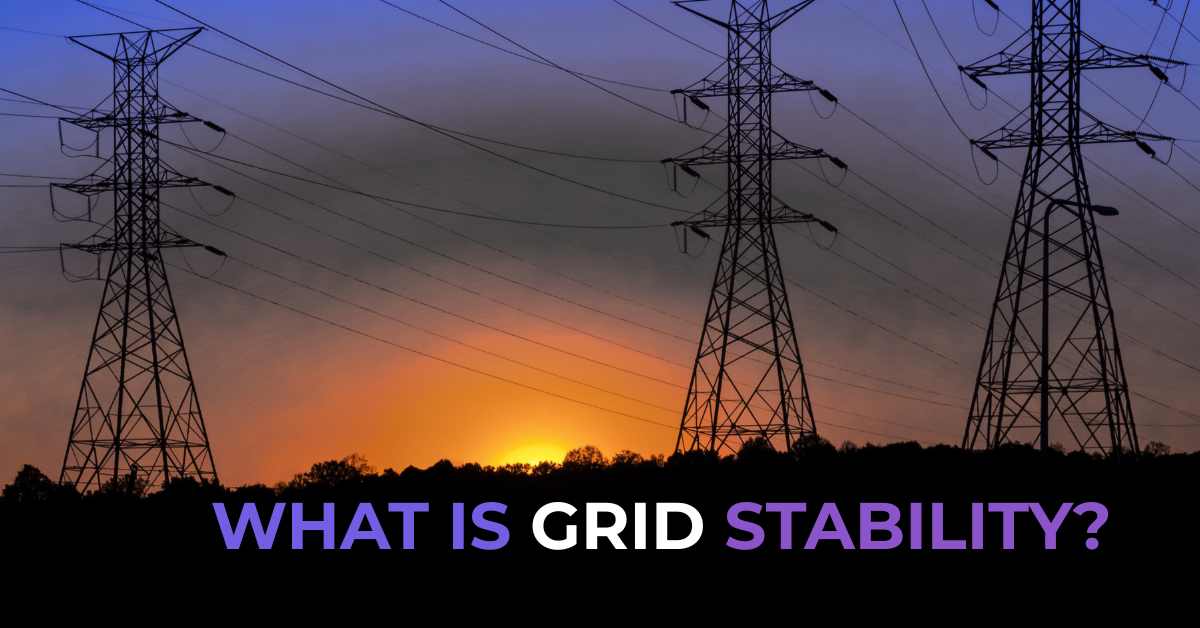
Grid stability refers to the ability of a power system to maintain normal operating conditions, primarily frequency and voltage within defined limits, in the face of disturbances, load changes, and generation variability.
For TSOs, stability is not an abstract engineering concept. It is the primary obligation. A stable grid keeps the lights on, protects critical infrastructure, and maintains the conditions under which markets can function. Instability means cascading failures, blackouts, and economic disruption.
For decades, stability was primarily a function of physical inertia: large spinning turbines in thermal and nuclear plants naturally resist frequency deviations, providing the system with a buffer against sudden imbalances.
As those plants are retired and replaced by inverter-based renewable generation such as wind turbines and solar PV, that mechanical inertia disappears. The system becomes faster and more sensitive, but also less forgiving.
Grid Stability Issues with Renewable Energy
The integration of renewable energy introduces three distinct stability challenges that TSOs and DSOs must address simultaneously.
• Frequency volatility
Variable renewable sources like wind and solar cannot be dispatched in the same way as conventional generation. When output drops unexpectedly, frequency can deviate faster than traditional balancing mechanisms can respond.
• Transmission congestion
This occurs when renewable generation exceeds the rated capacity of transmission corridors connecting them to load. Operators are forced to curtail clean energy, wasting generation and undermining investment economics.
• Voltage instability
Distributed energy resources such as rooftop solar, battery storage, and EV charging introduce bidirectional power flows that aging infrastructure was not designed to manage.
Electric Grid Stability: The Management Problem Nobody Is Talking About Enough
Grid instability today is primarily a management problem, not a supply problem.
The infrastructure and generation exists. What is frequently missing is the real-time intelligence to deploy both safely, efficiently, and in coordination.
Traditional static line ratings are calculated based on conservative worst-case assumptions. These conditions rarely occur simultaneously in practice. The result is that transmission lines often operate far below their true capacity.
Closing this gap requires advanced operational intelligence, combining real-time monitoring, predictive analytics, and system-wide visibility, capabilities that define the solutions developed by Enline.
Power Grid Stability and Renewable Energy: The Role of Dynamic Line Rating
What Is Dynamic Line Rating?
Dynamic Line Rating (DLR) replaces conservative static assumptions with real-time calculation of actual transmission line capacity.
Rather than assigning a fixed rating, DLR continuously evaluates true thermal capacity based on environmental and electrical conditions such as temperature, wind, and solar radiation.
The result is a transmission network that reflects reality rather than assumptions, unlocking 20 to 50 percent additional capacity under favorable conditions.
Why DLR Matters for TSOs, DSOs, and Utilities
For TSOs, DLR enables more renewable generation to flow, reduces curtailment, and defers capital-intensive upgrades.
For DSOs, it provides visibility into network constraints and improves coordination with distributed resources.
For utilities, it maximizes asset utilization while preparing for future demand growth.
Platforms like Enline extend these benefits by combining DLR with predictive analytics and system-wide intelligence.
The Digital Twin: The Intelligence Layer That Makes It All Work
A digital twin is a continuously updated virtual model of the grid that mirrors real-world conditions using live data and physical models.
It does not just show the current state. It simulates future states, identifies risks, and supports decision-making under uncertainty.
How Digital Twins Enable Grid Stability
Digital twins transform grid operations from reactive to predictive.
They enable operators to:
Identify emerging risks before failures occur
Prioritize maintenance based on probability and impact
Simulate investment scenarios before committing capital
Future-Proofing the Grid with Enline
The intelligence required to operate modern grids is not generic. It must be purpose-built for the physical realities of transmission and distribution systems. Enline delivers exactly this. Its platform combines Dynamic Line Rating, AI-driven analytics, satellite-based environmental data, and digital twin modeling into a unified solution that integrates seamlessly with existing grid systems.
Operators gain real-time visibility, forward-looking capacity forecasts, and actionable insights that transform grid management from reactive to predictive.
The grid of the future is intelligent and the time to build it is now.