Article
Dec 19, 2025
Digital Twins for Electric Utilities
The energy sector is changing fast. Digital twins for electric utilities are now essential tools for operators who must manage more renewables, more distributed generation and greater reliability demands.
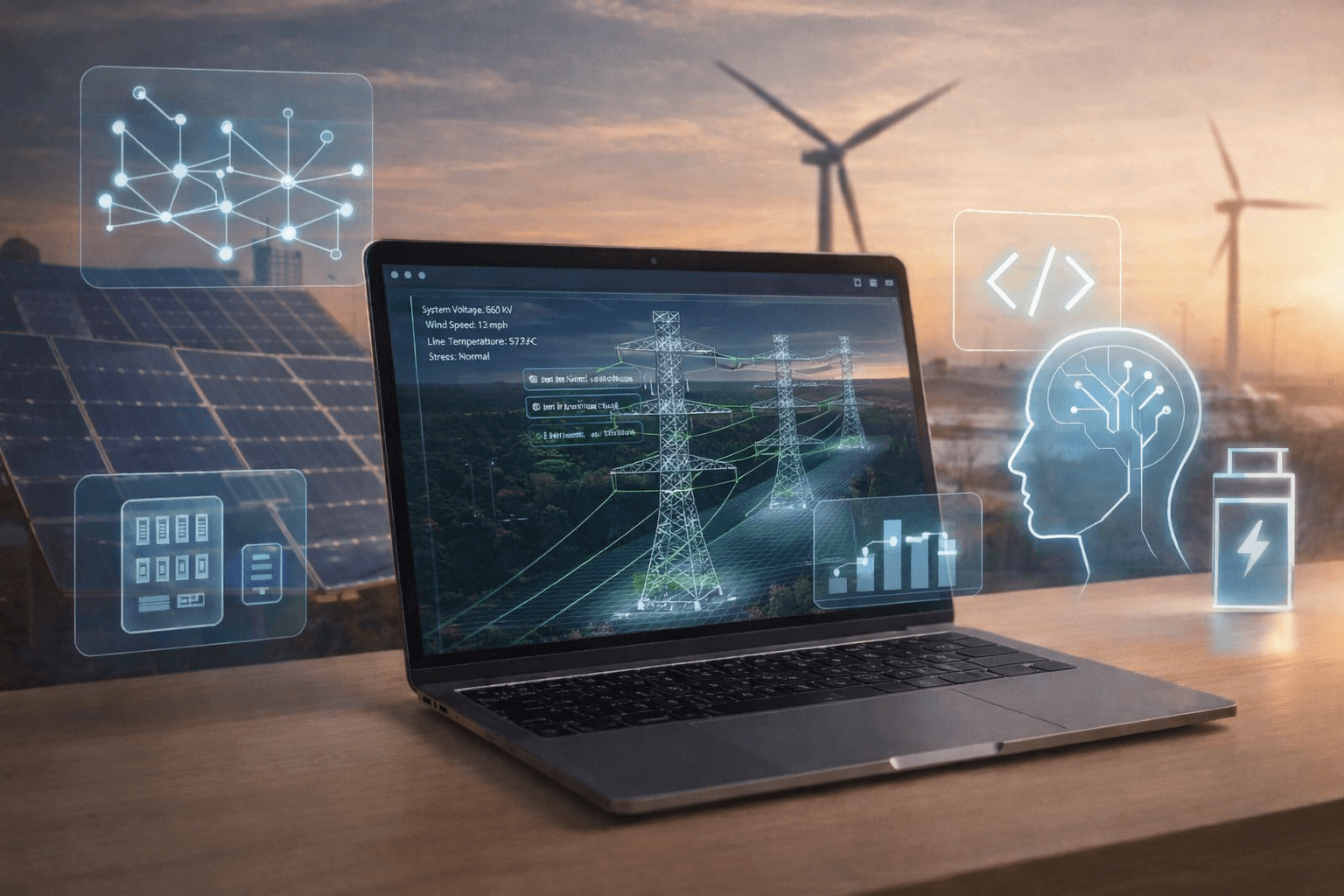
The global digital twin market was estimated at USD 24.97 billion in 2024 and is projected to reach USD 155.84 billion by 2030, reflecting rapid adoption across industries and energy systems.
Enline brings a software-first digital twin platform that offers real time visibility and AI driven decision making for generation, transmission and distribution.
The platform is modular and designed to scale. It helps utilities unlock unused capacity, reduce outages and integrate renewable energy while keeping hardware costs low.
Best Digital Twin Platform for Energy and Utilities Facility Management
Choosing one of the best digital twin platforms for energy and utilities facility management means selecting software that provides continuous monitoring, secure data integration and accurate simulations.
Enline delivers these features in a modular suite that integrates capacity models, network state estimation, vegetation management and AI powered optimization.
The system uses a digital twin model to represent lines, towers and substations in a unified environment.
Enline emphasizes a low hardware footprint. The platform can operate with sensorless dynamic line rating capabilities and leverage existing telemetry and public weather feeds.
This approach reduces capital expense and accelerates deployment when compared to sensor heavy rollouts. For utilities focused on fast results and low initial investment, a software centered twin often produces the best return.
What is a Digital Twin?
A digital twin is a dynamic virtual representation of a physical system. It receives data from meters, telemetry, SCADA and weather feeds to mirror real world conditions.
For utilities, a full network digital twin does more than show static models. It becomes a real time platform for forecasting, maintenance planning and operational control.
Enline expands that idea by integrating capacity models and AI in a single platform. The twin is designed to operate across generation, transmission and distribution. This end to end view helps planners and operators make aligned decisions from asset maintenance to market dispatch.
In simple words, a digital twin is a living digital copy of the grid. It shows how the grid behaves now and how it might behave in the future. It helps operators fix problems before they happen and use network assets more efficiently.
Enline’s twin gives operators a 360 degree view of line ampacity, conductor conditions, vegetation risk and voltage stability. This single view reduces blind spots and speeds up decisions.
What are the 4 Types of Digital Twins?
There are four common types of digital twins used in utilities:
Component twins for individual devices such as sensors or transformers.
Asset twins for whole equipment items such as a substation or turbine.
System twins for networks or feeders that show interactions among assets.
Process twins for operational workflows like maintenance schedules or dispatch procedures.
Enline supports these levels inside the same platform. This integrated approach helps teams move from component level metrics to system wide planning without data silos.
Digital Twin Applications for Utilities
Digital twin applications for utilities include many high value cases. Enline targets the most impactful ones that yield measurable operational improvements.
Dynamic Line Rating
Dynamic line rating calculates the safe current capacity of transmission lines in real time. This lets grid operators use ambient conditions, conductor behaviour and network constraints to increase usable ampacity where safe.
Grid studies and operator guidance show that dynamic assessment can reveal large capacity improvements over conservative static ratings, enabling more efficient use of existing assets and better renewable integration. Use of DLR can markedly reduce curtailment and congestion.
Vegetation Management
Vegetation along rights of way is a major cause of outages and wildfire risk. Enline combines digital twin mapping with predictive analytics to identify probable growth hotspots and priority trimming locations.
This allows utilities to replace fixed cycle trimming with risk based interventions, improving safety and reducing costs.
Network State Estimation
Accurate state estimation builds operational confidence where telemetry is sparse. Enline’s models fill observability gaps using physics based models and AI. This enables safer switching, faster fault detection and better situational awareness during high stress events.
Operational Simulation and Optimization
A comprehensive digital twin enables zero risk simulations. Operators can test demand spikes, resource dispatch strategies and grid topologies before applying them live.
Enline’s OptiMax module optimizes active and reactive power dispatch to reduce losses and maximize renewable throughput.
What is the Difference between a Digital Twin and a Virtual Twin?
A virtual twin is often a static model used for design or visualization. A digital twin is a dynamic, real time model that updates with live data and provides predictive analytics.
Enline’s solution is a true digital twin because it continuously ingests data and runs AI driven forecasts and optimizations. This makes it suitable for operational decision support, not just planning.
Are Digital Twins Real Time?
Yes. A proper digital twin integrates continuous data streams so that its model reflects current conditions. Enline operates in real time to evaluate line temperature, ampacity and network state, giving operators time critical alerts and optimization suggestions. Real time operation is key for handling renewable variability, managing congestion and reducing the risk of outages.
AI and the Digital Twin are Transforming Engineering
AI and the digital twin are changing engineering practice in power systems. AI models process large, diverse data sets and find patterns that humans cannot see in time.
This allows predictive maintenance, faster fault detection and optimized power flows. Because outages cost U.S. businesses roughly USD 150 billion per year, improving reliability also has clear economic value.
Enline combines AI with a modular digital twin to deliver practical improvements now. The platform is built for rapid deployment and low hardware cost, allowing utilities to realize benefits quickly while preparing their grids for higher renewable penetration.
Conclusion
Digital twins for electric utilities are no longer pilot projects. They are operational assets that enable safer, more efficient and more resilient grids. Verified market forecasts show fast growth in the digital twin sector. The economic case is strong when you consider outage costs and the value of unlocked capacity through dynamic line rating. Enline offers a modular, AI powered platform that brings these capabilities to utilities with minimal hardware burden and fast time to value.