Article
May 8, 2026
Renewable Energy Curtailment in 2026: The €7.2 Billion Problem the Energy Transition Cannot Ignore
Renewable curtailment hit record levels across Europe, Latin America, and Asia in 2025. Here is what is driving the €7.2 billion loss, the 2026 outlook, and the operational technologies utilities use to recover lost clean generation
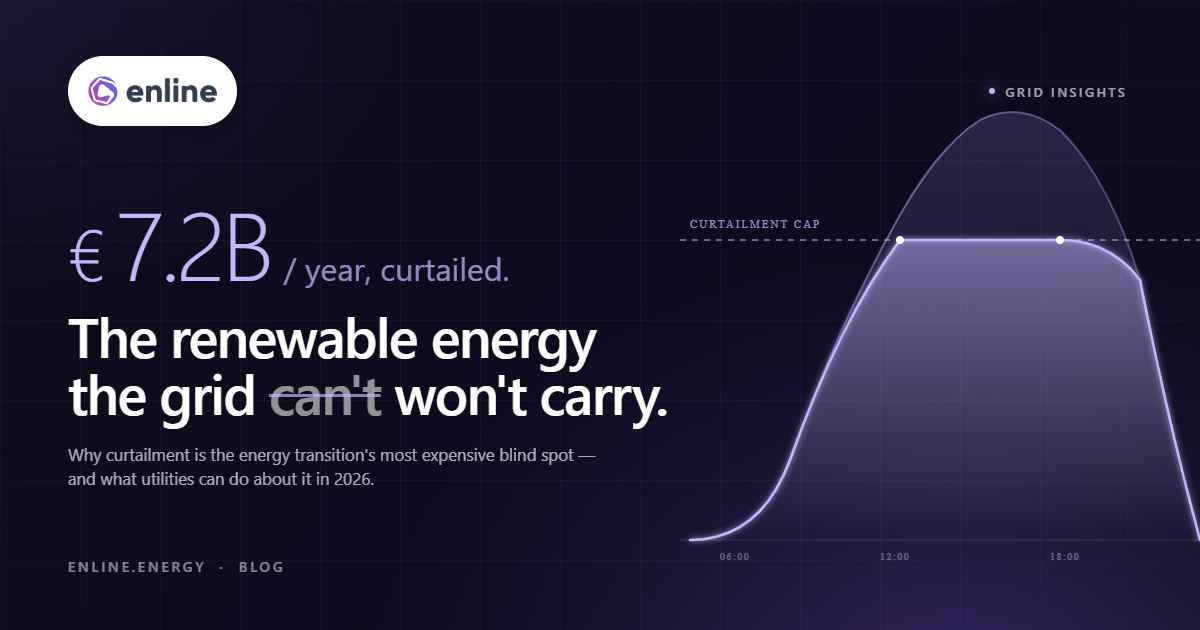
The numbers from 2024 to 2026 tell a clear story about renewable energy curtailment.
A May 2025 report by Beyond Fossil Fuels, E3G, Ember, and the Institute for Energy Economics and Financial Analysis found that €7.2 billion in renewable electricity was curtailed across just seven European countries in 2024. Roughly 1,700 GW of clean energy projects sit stranded in connection queues across the continent, more than three times the capacity the European Union needs to meet its 2030 climate goals.
In July 2025, Spain's curtailment rate climbed to almost 11% of renewable output. Chile recorded 5,908 GWh of vertimiento in 2024, a 149% increase over 2023. In Brazil, 20.6% of solar and wind generation was curtailed in 2025, more than double the previous year's 9.3%. The Ember Global Electricity Review 2026 confirmed that renewables overtook coal in the global generation mix for the first time in more than a century during 2025, with global solar generation rising 636 TWh, a 30% year-over-year increase. The energy transition is accelerating. So is curtailment.
What Is Renewable Energy Curtailment?
Curtailment is the deliberate reduction or shutdown of electricity generation from a power plant, typically a wind or solar farm, when the grid cannot safely absorb its output. The term changes by market. In Spain it is restricciones técnicas. In Germany it is Einspeisemanagement. In Chile, vertimiento. In Brazil, the English word curtailment is used directly. The concept does not change: clean energy produced and never delivered.
Curtailment renewable energy meaning matters because the financial losses are now material. In 2024, Germany alone curtailed up to €3.3 billion worth of wind and solar power, while Spain curtailed up to €2.5 billion, according to Beyond Fossil Fuels analysis. These are not edge cases. They are structural features of high-renewable markets.
The Curtailment Renewable Energy Rate Across Key Markets
Looking at the global picture, the renewable curtailment rate varies sharply by region.
In North America, the U.S. Energy Information Administration reported that the California Independent System Operator (CAISO) curtailed 3.4 million megawatt-hours of utility-scale wind and solar in 2024, a 29% increase from 2023. Curtailment of solar energy accounted for 93% of the total. This is curtailment of renewable energy in California at the visible edge of what U.S. grids are currently absorbing, and the trajectory through 2025 has continued upward.
In Latin America, Brazil's National System Operator data shows 20.6% of solar and wind output was curtailed in 2025, with sector losses estimated at $1.23 billion according to Volt Robotics. Chile lost 5,908 GWh to vertimiento in 2024, equivalent to 17% of available variable renewable energy.
Across Europe, Spain's July 2025 monthly curtailment of nearly 11% marked the highest level on record. Operating costs across the Spanish system rose by 49% year-over-year, reaching €3.77 billion as Red Eléctrica adopted reinforced security measures following the April 2025 Iberian blackout. Germany's solar curtailment jumped 97% in 2024 to 1,389 GWh, with compensation costs reaching €554 million.
Renewable energy curtailment in Australia and India follows a similar pattern as renewable build-outs accelerate. Both markets are still earlier in the curtailment curve than Europe and Latin America, but the underlying mismatch between renewable deployment speed and transmission expansion is the same. China saw H1 2025 solar curtailment climb to 6.6%, up from 3.9% the prior year, despite significant ultra-high-voltage transmission additions.
Curtailment Risk in Renewable Energy: A Problem or an Opportunity?
The framing of renewable energy curtailment as a problem or an opportunity has shifted. Project developers and grid operators now treat curtailment risk in renewable energy as a primary input to financial modeling.
For utilities and TSOs, the curtailment issues in renewable energy create both political and operational pressure. When clean energy is wasted while consumer bills rise to cover compensation payments, public and regulatory tolerance narrows quickly.
Operational Levers to Reduce Renewable Curtailment
There are three near-term operational tools that have demonstrated measurable results.
The first is Dynamic Line Rating. Most transmission curtailment events happen on lines that have additional thermal headroom under real weather conditions. DLR continuously measures actual conditions and recalculates capacity in real time, commonly unlocking 10% to 40% additional capacity on existing lines. The U.S. Department of Energy and Idaho National Laboratory both classify DLR as a strategic Grid Enhancing Technology.
The second is battery energy storage. Ember's analysis of 2025 deployment shows that battery capacity installed globally in 2025 was sufficient to shift roughly 14% of new solar generation from midday to other hours of the day. California reduced solar curtailment growth in 2025 partly through grid-scale storage additions.
The third is AI-powered network state estimation. Many curtailment decisions are made under partial visibility. Enline's network state estimation module fills in unmeasured network states from sparse sensor data, helping operators distinguish genuine constraints from conservative assumptions.
These tools work alongside, not in place of, transmission expansion. Enline's modular digital twin platform is built around exactly that operational reality: deliver capacity now, layer in further capability as the grid evolves.
To see how Enline's DLR and digital twin technology have helped utilities recover curtailed generation, book a free demonstration.