Article
Dec 18, 2025
How AI is Solving Energy Grid Problems Worldwide
Artificial intelligence is helping solve some of the most persistent challenges facing modern energy grids.
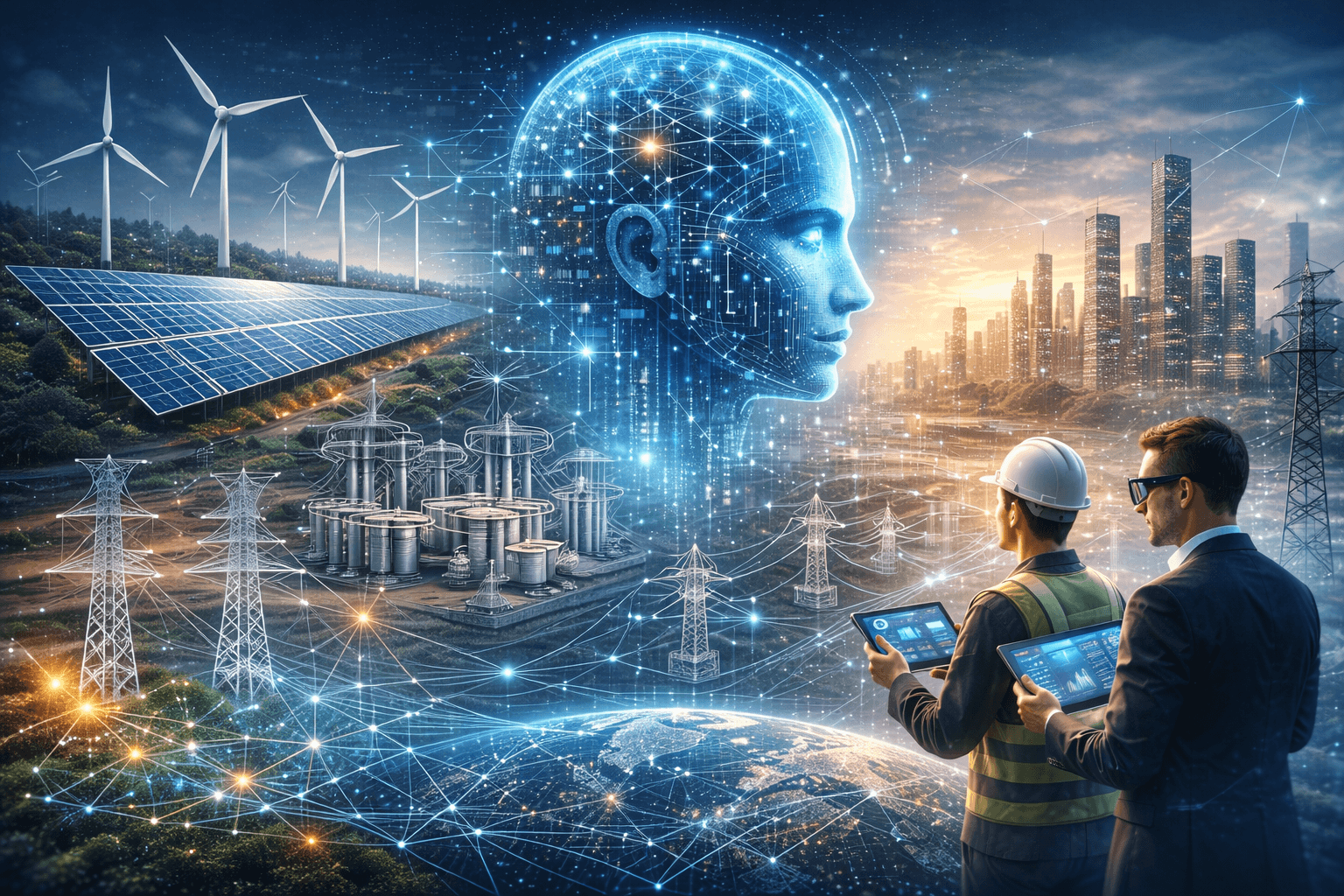
Interest in AI energy technologies has grown rapidly as utilities and governments invest in digital modernization. According to DataM Intelligence, the global AI in energy market reached about 9.89 billion dollars in 2024 and is projected to grow to 99.48 billion dollars by 2032, with a compound annual growth rate above 30 percent.
In 2025, multiple independent research firms reported that the global smart grid market reached roughly 66 to 74 billion dollars in 2024, with strong projected growth through 2028 and beyond. The main drivers include AI adoption, advanced metering, distribution automation and renewable integration.
Likewise, Digital twin adoption is expanding. Grand View Research estimates that the global digital twin market reached 24.97 billion dollars in 2024 and is expected to grow rapidly through 2030. This reflects increased demand for simulation-based planning, predictive maintenance and real time asset optimization.
The U.S. Department of Energy (DOE) notes that AI is now essential for strengthening grid resilience, improving forecasting accuracy and supporting rapid decision making during operational stress events. This importance increased in 2025, when the DOE announced more than 320 million dollars in new AI investments to improve scientific modeling, infrastructure planning and energy resilience across the United States.
At the same time, electricity networks worldwide are experiencing heavier stress. The U.S. Energy Information Administration reported in November 2025 that 2024 produced the most annual hours without power in more than a decade for American customers.
This rising outage frequency increases economic losses and reinforces the need for advanced AI tools.
Smart grids help address these challenges. The International Energy Agency defines smart grids as electricity networks that use digital technologies and software to balance supply and demand efficiently. AI gives these systems the intelligence required to respond to real time changes in consumption, weather and renewable production.
Enline supports this shift through an AI powered digital twin platform that provides real time visibility across transmission and distribution networks so operators can optimize capacity, reduce congestion and prevent outages.
Generative Artificial Intelligence for the Power Grid and Modern Utilities
Generative artificial intelligence for the power grid introduces new capabilities for modeling, planning and operational simulation. Instead of relying only on predictive models, generative AI can create full scenarios that forecast how the grid might respond to future conditions. These scenarios help utilities test switching strategies, maintenance decisions and renewable dispatch options before implementing them in the live grid.
The DOE applied this principle directly in 2025 through its PermitAI initiative, which uses generative AI to process federal environmental documents, accelerate permitting and support faster deployment of transmission and energy projects. This reduces regulatory delays and accelerates infrastructure modernization.
Enline integrates generative AI into its digital twin models to create accurate operational simulations. These models help utilities evaluate how temperature, wind, renewable variability or asset deterioration could affect line capacity and network stability.
Operators can experiment with operating conditions and identify the safest and most efficient strategies before applying them on the real grid.
Understanding AI Power Grid Consumption and Load Forecasting
How do you forecast electricity demand when millions of homes, factories and vehicles all behave differently every hour of the day? This is the challenge AI power grid consumption modeling is designed to solve.
With smart meters and IoT sensors sending continuous streams of data, AI can map when, where and how energy is being used across an entire region. These models analyze consumption patterns in real time to predict short term and long term load fluctuations. Accurate forecasting helps utilities reduce strain on generation assets, minimize imbalances and prevent grid instability before it occurs.
Deep learning approaches such as LSTM (Long Short Term Memory) networks have demonstrated strong performance in load forecasting globally. Utilities that apply AI-based forecasting can reduce reserve margins and operate systems closer to real demand conditions without sacrificing reliability. The National Grid in the United Kingdom has reported improved accuracy by applying AI-driven forecasting systems.
Now, Enline enhances load forecasting by combining real time telemetry with digital twin insights. The system incorporates weather data, renewable production forecasts and historical patterns into a single operational model. This approach improves short term and long term demand forecasting and strengthens system reliability.
How Generative AI Improves Power Grid Operations in Real Time
Generative AI improves real time operations by helping operators understand the consequences of potential actions before they are taken.
The technology can simulate demand spikes, equipment failures, and renewable variability events. It can also evaluate how infrastructure constraints might evolve under different conditions.
This approach supports operators in making informed decisions quickly. For example, generative AI can help evaluate the benefits of alternative switching operations, optimal battery dispatch, or reactive power adjustments. It can also identify the safest way to manage transmission congestion or voltage instability.
Why AI Grid Management Is Essential for the Future of Energy Reliability
AI grid management systems improve the reliability and adaptability of the grid by monitoring asset performance, analyzing real time conditions and recommending corrective actions. The technology identifies anomalies, predicts failures, and optimizes network configurations based on evolving conditions.
As renewable energy grows, grid variability increases. AI helps manage this complexity through better forecasting, load balancing and storage dispatch. AI also supports vegetation management and risk mitigation by analyzing satellite imagery, weather data and historical outage trends.
Enline provides these capabilities through modules such as Dynamic Line Rating, Vegetation Management and Network State Estimation. These tools give operators real time insight into network capacity, environmental risks and asset performance.
Energy Grid Optimization with AI and Digital Twin Technologies
Energy grid optimization involves managing power flows, reducing losses and improving operational flexibility. AI and digital twins are important tools for achieving these goals.
In 2025, several global studies emphasized that AI-based optimization improves renewable forecasting, energy storage coordination and congestion management. IRENA reported that digital technologies, including AI and digital twins, help reduce renewable curtailment and improve grid stability.
Enline’s OptiMax module optimizes active and reactive power flow in real time. The system evaluates line capacity, predicts congestion and recommends actions that allow utilities to maximize renewable generation and reduce stress on equipment.
AI improves renewable integration by analyzing weather data, production history and ambient conditions. These models help predict solar and wind generation accurately and provide operators with insights into optimal dispatch strategies.
AI also improves the operation of battery storage. By analyzing demand patterns and price signals, AI decides when storage should charge or discharge. These optimizations improve grid resilience during peak demand periods.
Conclusion
AI is transforming grid operations by improving forecasting, strengthening resilience and enhancing the integration of renewable energy. The events and investments of 2025 demonstrate the increasing importance of AI for planning, simulation and real time decision making. Enline supports this transformation with a digital twin platform that provides real time visibility and predictive intelligence. As utilities modernize their systems, AI will continue to play a central role in delivering a more reliable, efficient and sustainable energy grid.